
Local Health Authorities Analytical Committee (LHAAC)
From Bottlenecks to Breakthroughs: How LHAAC Transformed Public Health Operations with M-Files
Highlights
- Financial approvals completed in minutes instead of days, thanks to M-Files’ automated workflows, mobile access, and real-time visibility—dramatically improving efficiency and reducing administrative bottlenecks.
- Digitized and centralized document management, replacing paper-based archives with a searchable, secure, and compliant digital platform streamlining retention, retrieval, and audit readiness.
- Significantly enhanced governance and collaboration, with M-Files enabling secure access, version control, and seamless information sharing across geographically dispersed teams and external auditors.

Use Case
Compliance Management
Process Management
Remote Work
Industry
Medical & Health
Country
Australia
Share This Story
Company Introduction
The Local Health Authorities Analytical Committee (LHAAC) is a public health entity under the Western Australian state government, working exclusively with local governments across the state. Its primary role is to coordinate a sampling scheme that enables local governments to access analytical services for substances with potential public health implications—such as food, water, air, and other environmental materials.
LHAAC oversees the funding for these sampling activities and partners with both private and government laboratories in Western Australia to conduct commissioned analyses. The organization is led by Coordinator Ryan Janes, who reports to a 10-member committee representing various local government agencies. Ryan and the administrative team operate from office space located at Edith Cowan University (ECU), a prominent institution in Western Australia. Functioning similarly to a board, the committee meets regularly to review analytical outcomes, facilitate information sharing among stakeholders, and guide future sampling and research priorities.
Key Challenges Before M-Files
Challenges with Collaboration and Information Sharing
Before adopting M-Files, LHAAC relied heavily on manual, paper-based systems that significantly hindered governance, collaboration, and administrative efficiency. The organization faced several key challenges that impacted on its day-to-day operations and strategic focus.
Collaboration was particularly difficult due to the distributed nature of the committee. With members drawn from various local government agencies and staff based at a university, LHAAC functioned similarly to a board and was subject to external audits. However, the existing systems made it challenging to share information securely. Ensuring that sensitive data was accessible only to authorized personnel was cumbersome, and auditors often encountered difficulties accessing the necessary documentation.
Inefficient Document Retrieval and Storage
Locating information was another major hurdle. Documents were stored in a folder-based system organized by broad topics or years, which made searching time-consuming and unintuitive. Staff, committee members, and auditors frequently spent excessive time trying to find key documents, which slowed down workflows and decision-making.
Document storage practices further complicated access. A combination of hard drive storage and physical paper files made it difficult for geographically dispersed members to retrieve information efficiently. Sharing hard copy documents required scanning and emailing, which introduced delays and inefficiencies.

"When I was looking at M-Files, I was expecting it to be a fairly standard kind of document management system. It's ended up being so much more than that. To be honest, I don't know how people could say no to M-Files. It is just amazing - I love it. Thank you for making my life easier."
Ryan Janes, Coordinator, LHAAC
Manual Retention and Compliance Burdens
Managing legislative retention requirements was also a burdensome task. Under the manual system, staff had to track and monitor records manually to determine when documents could be destroyed. This process diverted valuable time and attention away from more strategic responsibilities.
Cumbersome Approval Processes
Approval processes, such as those for accounts payable, were time-consuming and inefficient. They involved printing, signing, scanning, and compiling documents, often taking hours to complete. These processes created bottlenecks, especially when approvers were unavailable.
Lack of Version Control and Data Security
Version control posed yet another challenge. Without a centralized system, confusion over document versions was common. Staff and auditors frequently had to verify whether they were working with the most up-to-date version, and in some cases, documents were unnecessarily recreated.
Reliance on hard drives and paper files introduced significant risks related to data loss and security. Hard copies were vulnerable to unauthorized access, and the electronic folder system lacked the flexibility to enforce access controls while still enabling secure sharing with external users.
The Need for an Efficient Knowledge Work Automation Platform
Recognizing these inefficiencies, Ryan and the LHAAC team concluded that their existing information management systems were undermining the committee’s ability to fulfill its legislated functions and strategic goals. They identified the need for a more efficient and secure system to manage analytical reports, sensitive research data, financial records, governance documents, and historical information. After reaching out to Innovative Content Management and discovering M-Files, the team found a solution that transformed their operations.

"Transitioning to M-Files reduced the average time for processing financial approvals from several hours or even a full day under the old paper-based system to as little as 10 minutes. This improvement is due to digital workflows, streamlined document sharing, and reduced reliance on email attachments. This reflects a significant efficiency gain and suggests broader operational time savings across LHAAC."
Ryan Janes, Coordinator, LHAAC
The M-Files Solution
Enabling Enterprise-Grade Transformation
Faced with growing operational complexity and the limitations of legacy systems, LHAAC recognized the need for a modern platform to support its evolving mandate. Eight months into his tenure, Ryan initiated a strategic search for a Knowledge Work Automation solution capable of delivering enterprise-level scalability, security, and configurability.
After evaluating several platforms—including Microsoft SharePoint—LHAAC selected M-Files for its unmatched ability to support complex, distributed operations while maintaining independence from institutional infrastructure. M-Files stood out for its metadata-driven architecture, deep Microsoft 365 integration, and cloud-native deployment model, making it the ideal choice for a public sector organization with high compliance and governance standards.
Enterprise-Ready Security and Accessibility
As a government entity, LHAAC required a solution that could meet stringent data protection and access control requirements. M-Files Cloud, hosted on Microsoft Azure, delivered enterprise-grade security with end-to-end encryption, role-based permissions, and geographically redundant storage. The platform’s flexibility enabled secure access for users across multiple locations—without reliance on a shared local network—ensuring both agility and compliance.
Tailored for Strategic Impact
Implementation was led by a Certified M-Files Solution Engineer from partner Innovative Content Management, who worked closely with LHAAC to design a custom metadata structure aligned with the organization’s strategic priorities. This included support for research and analytics, financial governance, stakeholder engagement, and historical archiving—ensuring the platform could scale with LHAAC’s mission.
The Results
Automated Financial Workflows
M-Files enabled LHAAC to digitize and automate its financial approval processes, eliminating manual bottlenecks and reducing approval times from days to minutes. Smart workflows routed approvals to designated stakeholders, while integrated banking data and linked documentation streamlined processing and reduced administrative overhead.
As Ryan explains, “Transitioning to M-Files reduced the average time for processing financial approvals from several hours or even a full day under the old paper-based system to as little as 10 minutes. This improvement is due to digital workflows, streamlined document sharing, and reduced reliance on email attachments. This reflects a significant efficiency gain and suggests broader operational time savings across LHAAC.”

Real-Time Visibility and Control
Dynamic dashboards and mobile access empowered staff and committee members to manage approvals on the go, with full transparency into workflow statuses and audit trails. Automated permissions control ensured that only authorized users could access sensitive financial data, reinforcing internal controls and audit readiness.
Digitized Archives and Smart Search
LHAAC transitioned from paper-based archives to a fully digital solution. Using M-Files’ Optical Character Recognition (OCR) and Google-style search, staff could instantly retrieve indexed documents—dramatically improving productivity and reducing physical storage needs. Retention policies were automated using M-Files’ Property Calculator, ensuring compliance with government-mandated timelines.
Elevated Governance and Compliance
M-Files delivered a centralized, secure environment for all content types—from analytical reports to governance documentation. Automated version control, metadata tagging, and retention rules ensured that LHAAC met its compliance obligations with confidence. External audits became faster and more efficient, with read-only access reducing staff workload and improving transparency.
Strategic Outcomes
- >90% reduction in approval cycle times
- Full compliance with public sector retention and audit standards
- Digitization of legacy archives, improving access and freeing physical space
- Streamlined collaboration across distributed teams and external stakeholders
- 5/5 satisfaction rating from leadership for usability and impact

Delivering Measurable Impact Across the Organization
The impact of implementing M-Files at LHAAC has been overwhelmingly positive. Ryan says of M-Files, “The time saving and the efficiency in our internal processes has just been fantastic.” Ryan rated M-Files a 5 out of 5, highlighting its ease of use and the significant efficiencies that M-Files the solution has brought to LHAAC’s daily operations.
"When I was looking at M-Files, I was expecting it to be a fairly standard kind of document management system. It's ended up being so much more than that. To be honest, I don't know how people could say no to M-Files. It is just amazing - I love it. Thank you for making my life easier", Ryan concluded.
Partner
Innovative Content Management
Innovative Content Management is a consulting firm specializing in products and services that enhance workplace productivity. We specialize in tailored solutions for efficient digital document and content management.
Our mission is to make organizations across a wide variety of sectors more economically, environmentally, and socially sustainable. We are passionate about making real, positive differences to individuals and their organizations.
By leveraging the M-Files platform, we help organizations achieve a true paperless operating environment. We enhance knowledge workers’ lives by helping achieve greater productivity and an enhanced work-life balance.
We have a proud history of working collaboratively with our clients to optimize their M-Files solution. Over the past 23 years we have successfully implemented hundreds of document management software solutions. We also pride ourselves on supporting our clients through comprehensive post-implementation customization and training services.

Contact



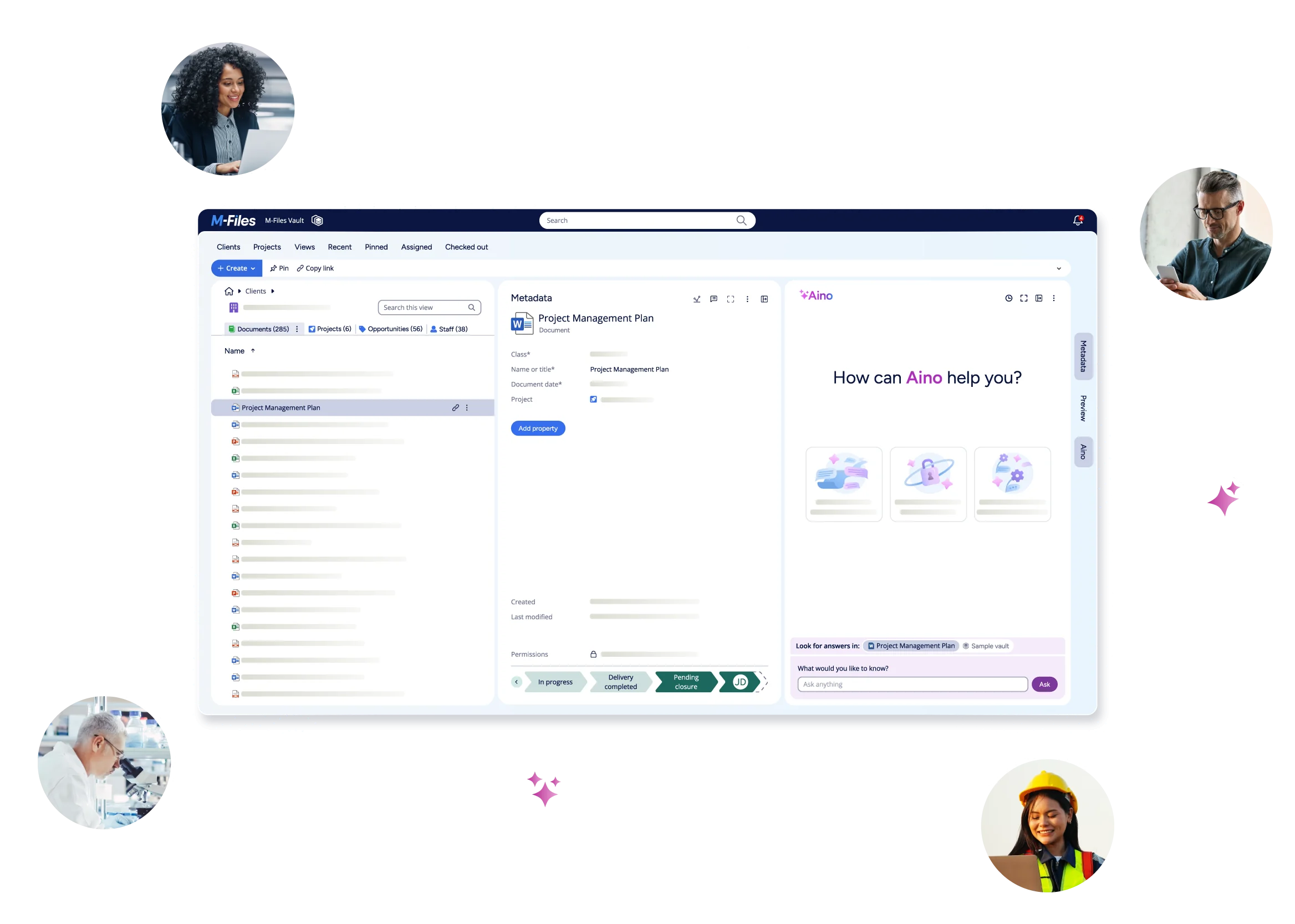
See M-Files in Action
Seeing is believing. Explore M-Files your way. Choose a live demo or a free 30-day trial to experience AI-powered content in context.