
Why Engagement Context Matters in Tax Advisory
Why Engagement Context Is the Future of Tax Advisory Work

And why document management alone can no longer support modern engagement delivery
Over the past decade, tax advisory firms have invested heavily in technology.
Practice management systems track time and billing. Tax software handles calculations and filings. Collaboration tools support communication. Document management systems store workpapers and deliverables.
Each system solves a specific problem.
Yet none of them models the engagement itself as a connected system of work.
Instead, engagement context is scattered across tools. Professionals reconstruct it manually while managing deadlines, reviews, and client expectations.
As advisory work becomes more complex, this fragmentation becomes more than an inconvenience.
It becomes a structural constraint.
The future of tax advisory execution will not be defined by more tools.
It will be defined by how well firms structure engagement context.
What Engagement Context Really Means in Tax Advisory
Engagement context is the structured relationship between everything that defines an engagement.
It includes the client, engagement type, deliverables, workpapers, deadlines, assigned roles, review stages, approval requirements, and compliance obligations.
In most firms, these elements exist. But they are not connected.
A workpaper lives in a shared drive. A deadline sits in a practice management system. A review happens in email. An approval is tracked informally. Compliance requirements live in policy documents.
To understand the state of an engagement, professionals must assemble this information manually.
That process takes time. It introduces risk. It creates inconsistency.
When engagement context is structured inside the system, those relationships are captured once and reused throughout the engagement lifecycle.
Execution becomes clearer. Visibility improves. Coordination decreases.
Why Traditional Tax Document Management Falls Short
Tax document management software plays an important role. It centralizes files, enables search, and maintains version control.
But it is built around documents, not engagements.
A document management system can tell you where a file is stored. It cannot tell you how that file fits into the engagement.
It does not inherently track whether a document is under review, whether it has been approved, or what action needs to happen next.
As a result, execution lives outside the system.
Tasks are tracked separately. Reviews are coordinated through email. Approvals rely on follow ups. Status visibility requires manual updates.
The system stores information, but it does not structure the work.
This is where operational friction begins.
Fragmentation Changes How Firms Operate
When engagement context is fragmented, coordination becomes a core activity.
Managers spend time reconciling status across systems instead of managing flow. Associates search for relevant documents instead of progressing work. Partners request updates instead of seeing engagement health in real time.
Over time, this affects more than efficiency.
Review cycles extend because bottlenecks are not visible early. Approval delays increase because ownership is unclear. Compliance risk rises because lifecycle controls are not consistently enforced.
Even well designed processes break down when the system does not support how work actually happens.
Why Workflow Automation and AI Often Stall
Many firms attempt to solve these challenges with workflow automation or AI.
They automate document routing. They introduce approval workflows. They experiment with AI for summarization or drafting.
These efforts often deliver incremental improvements.
But they rarely transform execution.
The reason is simple.
Automation and AI both depend on structured context.
If engagement phases are not defined in the system, workflow triggers are unreliable. If documents are not linked to engagement type or deliverables, automation becomes inconsistent.
AI faces the same limitation. Without structured relationships between documents, tasks, and approvals, AI cannot reliably interpret what matters.
It may generate output, but it cannot guarantee relevance or accuracy.
Without engagement context, both automation and AI remain constrained.
Engagement Centric Delivery Changes Execution
To reduce operational friction, firms must shift from managing documents to managing engagement context.
This means structuring work around the engagement itself.
In an engagement centric model, documents, tasks, reviews, approvals, and governance are connected within a single system.
Execution becomes visible.
Ownership becomes clear.
Progress can be tracked without manual coordination.
This is the approach behind M-Files for Tax Advisory.
How M-Files for Tax Advisory Structures Engagement Context
M-Files for Tax Advisory is a purpose-built engagement centric workspace designed specifically for how tax advisory teams deliver client work.
Tax Advisory Product Solution B…
Instead of organizing information around folders, it organizes work around the engagement.
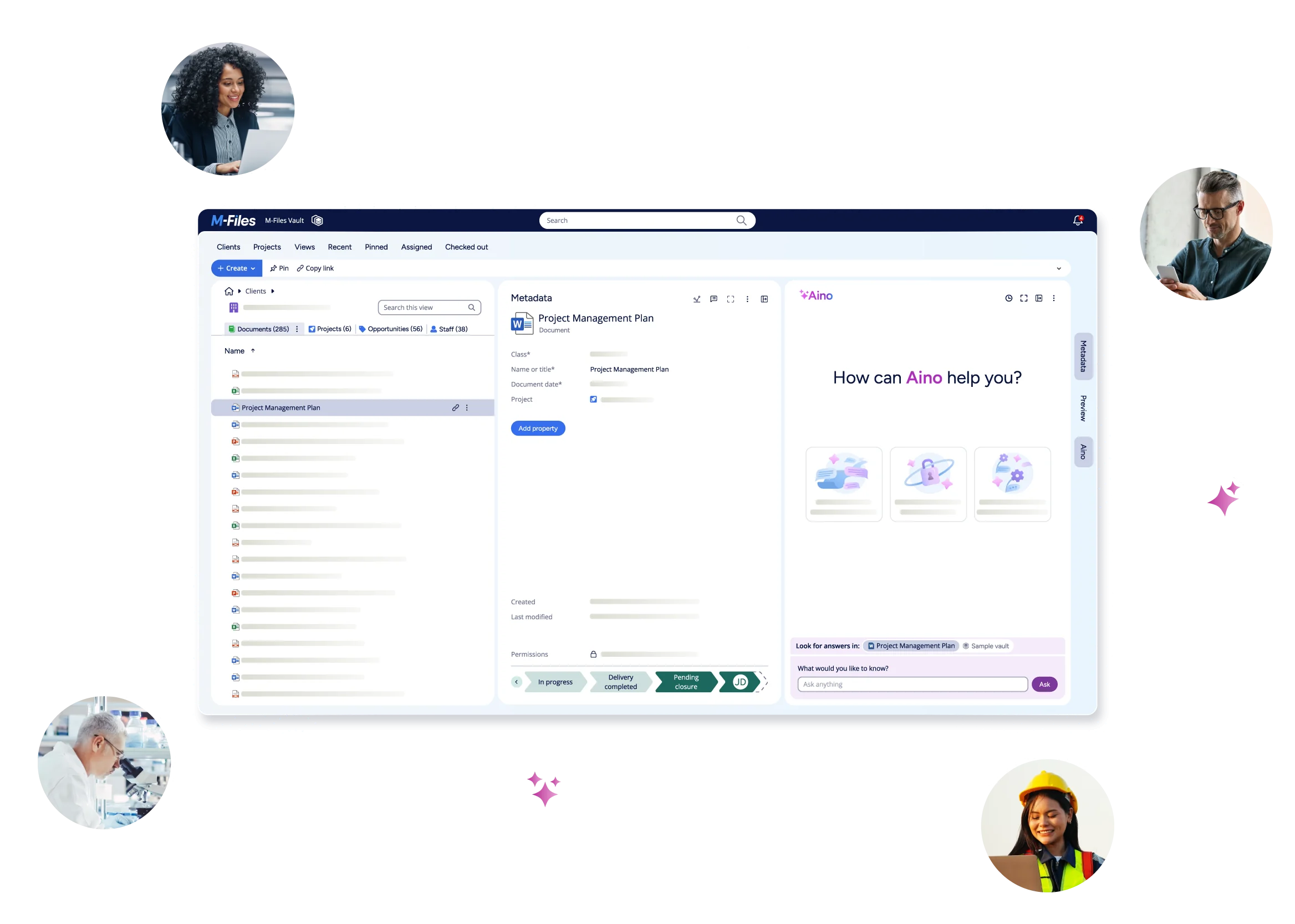
Each engagement brings together documents, tasks, review assignments, approval assignments, and status indicators into a structured view.
The engagement becomes the system of record for both execution and governance.
A Work Item Model That Drives Execution
At the core of the solution is a clear work item model.
Tasks drive day to day execution. Review assignments coordinate document review. Approval assignments manage formal sign off.
These work items are visible within the engagement and across role specific dashboards.
Work is no longer hidden in email threads or spreadsheets. It is structured, trackable, and aligned to the engagement lifecycle.
This reduces status chasing and improves accountability across teams.
Role Based Engagement Visibility
When engagement context is structured, each role gains clarity aligned to their responsibilities.
Partners gain visibility into portfolio health, pending approvals, and emerging risks. Managers can track progress, monitor review queues, and identify bottlenecks. Associates see prioritized tasks and access relevant documents within the engagement context.
Instead of switching between systems, each role works from a unified view.
This reduces coordination overhead and improves execution flow.
Governance Without Adding Burden
Governance is critical in tax advisory, but it often introduces friction when applied manually.
M-Files for Tax Advisory embeds permissions, lifecycle controls, and auditability directly into the engagement structure.
These controls operate in the background, ensuring consistency and traceability without requiring users to manage process states.
The result is stronger compliance with less administrative effort.
AI That Works Because Context Exists
AI only delivers value when it understands context.
Because M-Files for Tax Advisory connects documents, tasks, and engagements structurally, AI can operate within meaningful relationships.
It can summarize engagement status, surface relevant information, and suggest next steps within the flow of work.
This makes AI more practical and more reliable for tax advisory teams.
Built to Enhance Existing Systems
M-Files for Tax Advisory is delivered via cloud and enhances Microsoft 365 and other firm systems, including practice management and CRM tools.
It does not replace existing investments.
Instead, it brings structure and visibility to engagement execution while working within the firm’s current ecosystem.
This approach reduces complexity and accelerates time to value.
What Changes in Practice
When engagement context is structured, daily work changes in meaningful ways.
Managers spend less time chasing updates and more time managing delivery. Associates spend less time searching and more time completing work. Partners gain confidence in engagement status without relying on manual reporting.
Review cycles become more predictable. Approval bottlenecks become visible earlier. Rework decreases because version confusion is reduced.
Execution becomes smoother because coordination is built into the system.
The Future of Tax Advisory Work
Tax advisory firms do not need more tools.
They need better structure.
As regulatory complexity increases and AI adoption accelerates, firms that rely on fragmented systems will struggle to scale.
Firms that structure engagement context will gain a measurable advantage.
They will deliver work more consistently, manage risk more effectively, and unlock the full value of AI and automation.
Engagement context is not a feature.
It is the foundation of modern advisory execution.
The Bottom Line
Document management organizes files.
Engagement context organizes work.
M-Files for Tax Advisory transforms document management into engagement centric execution by connecting documents, tasks, reviews, approvals, and governance in one structured system.
You do not need more tools.
You need engagement clarity.
Ready to Move Beyond Fragmented Engagements?
See how M-Files for Tax Advisory helps your firm reduce operational friction and gain execution control.
Request a demo or schedule a strategy session to evaluate how your engagement architecture supports performance.
Frequently Asked Questions
Latest Articles
Browse Topics
Resources
See M-Files in Action