
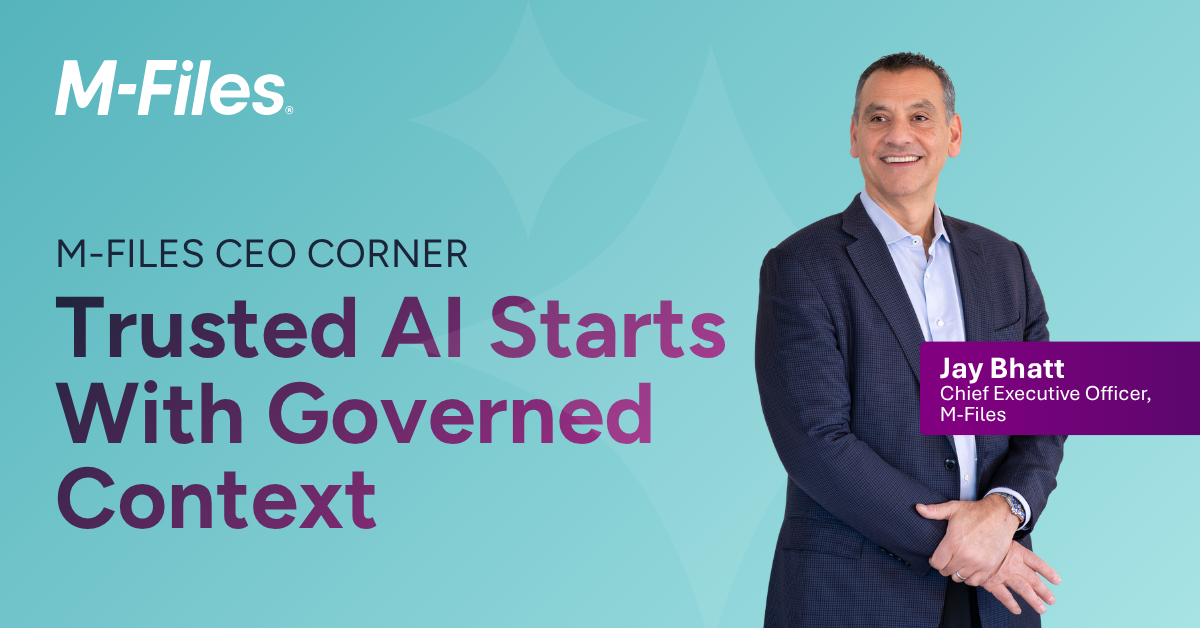
Trusted AI Starts With Governed Context
Trusted AI Starts With Governed Context

For years, I’ve believed that M-Files was onto something fundamentally different.
Long before I joined as CEO, I saw a company that understood a simple but powerful truth: documents are not just files, they're the backbone of how businesses operate.
The market caught on, but not to the level it should.
That changed with M-Files being named a Leader in the 2026 Gartner® Magic Quadrant™ for Document Management. This is an incredible accolade that our teams are proud to celebrate. But more importantly, we see it as validation of the need for document context and governance to make trusted decisions.
The Problem: AI Without Context Doesn’t Work
There’s no shortage of excitement around AI right now. And rightly so. It is one of the most significant technological shifts of our time.
But there’s also a growing gap between expectation and reality. Most organizations are experimenting with AI and so few are operationalizing it at scale.
Because AI is only as effective as the information it operates on.
Over the past year and a half, I've talked with customers, prospects, analysts, and business peers and the conversations were similar. Information is fragmented across systems; lacks context; is often inconsistent, duplicated, or outdated; and governed unevenly.
The fact of the matter is that most enterprise knowledge still lives in documents like contracts, audit files, engineering specs, and customer records. All this information has significant value, but is often spread across applications like SharePoint, network drives, CRM and ERP systems, and more.
Without the right context, AI cannot understand meaning, establish trust, or act with confidence, which exposes inherent risks.
The Shift: From Managing Information to Driving Execution
Traditional document management systems were built as systems of record to store and retrieve information.
That model is no longer sufficient.
In our AI-driven world, organizations need modern document management that is both a system of record but also where information is connected, understood, governed, and activated through workflows and automation.
This is where M-Files is fundamentally different.
The M-Files Approach: Context First
From the beginning, M-Files built a context-first approach to document management where information is defined by what it is, how it relates to other information, and where it fits in the business process.
That's the power of our metadata-driven architecture and enterprise knowledge graph, which connects information across systems and creates a dynamic, contextual layer.
This is powerful because context is what enables:
- Automation – workflows that trigger based on meaning, not location
- Governance – policies and permissions that follow the content, wherever it lives
- Discovery – instant access to the right information, in the right context
- AI Readiness – structured, trusted inputs for intelligent systems
Context is what transforms static content into actionable knowledge.
Enabling Trusted, Agentic AI
The AI evolution is happening fast. In the new era of agentic AI, systems don’t just generate insights, they take action on behalf of users.
This is where the stakes get higher, forcing organizations to ask:
- Can I trust AI to act on my data?
- Is the information complete and accurate?
- Are governance, permissions, and compliance enforced?
The answers all point back to the quality and context of the underlying information. When content is unified across repositories, has built-in governance across systems, captures the right relationships between documents, data, and processes, it creates a trusted foundation for agentic AI experiences. However, in the agentic AI world, content and documents living without these things creates both a productivity and liability problem.
What Comes Next
Our Leader recognition from Gartner is an important milestone to celebrate.
As we look ahead, we have a significant opportunity to help organizations achieve their performance advantage with context, governance, and trust.
The future of work isn't about managing documents. It's about enabling trusted execution and decisions that start with context. ''
Latest Articles
Browse Topics
Resources
See M-Files in Action