

Audit Readiness and AI Readiness for Insurers
Why Audit Readiness Is Becoming a Measure of AI Readiness for Insurers

Insurance organizations are entering one of the most significant periods of transformation the industry has experienced in decades. Regulatory expectations continue to evolve, customer expectations are rising, and competition is increasingly driven by speed, service, and operational efficiency. At the same time, artificial intelligence has become a strategic priority for many insurers looking to improve underwriting, accelerate claims processing, automate administrative work, and deliver more personalized customer experiences.
Yet despite significant investments in policy administration platforms, customer relationship management systems, workflow automation, and digital transformation initiatives, many organizations are finding that AI is not delivering the business outcomes they expected. Pilot projects demonstrate promise, but scaling AI across the enterprise often proves far more difficult than anticipated. The technology itself is rarely the limiting factor. More often, the challenge lies in the quality, accessibility, and governance of the information AI depends on.
This shift is forcing insurance leaders to reconsider something they may have viewed primarily as a compliance exercise: audit readiness. Increasingly, an organization's ability to quickly locate trusted, governed, and traceable information is becoming a reflection of something much larger. It demonstrates whether the business has built the information foundation required not only for regulatory compliance, but also for operational excellence and trusted AI.
Insurance Doesn't Have a Document Problem. It Has a Context Problem.
Insurance has always been built on information. Every policy issued, underwriting submission reviewed, claim processed, endorsement approved, broker agreement executed, and regulatory filing completed depends on documents moving through the organization. These documents capture critical business decisions, provide evidence for regulators, support customer interactions, and preserve the institutional knowledge that enables insurers to operate effectively.
The industry has no shortage of places to store those documents. Policy administration systems, SharePoint, email, CRM platforms, claims applications, shared drives, broker portals, and specialized insurance systems all contain valuable information. Over time, however, these repositories often evolve independently of one another. Documents become separated from the clients, policies, claims, risks, and business processes that give them meaning. Employees may be able to find a document, but they cannot always determine whether it is the latest approved version, who authorized it, how it relates to other records, or whether they can trust it to make an important business decision.
This is fundamentally a context problem rather than a document problem. Information without business context forces people to recreate relationships that should already exist. Teams spend valuable time searching across systems, validating versions, confirming approvals, and piecing together complete customer histories before they can move work forward. Individually these delays may appear insignificant, but across thousands of policies, claims, and customer interactions they create a level of operational friction that affects nearly every part of the business.
Operational Friction Is Quietly Limiting Business Performance
Operational friction rarely attracts executive attention because it doesn't result from a single broken process. Instead, it accumulates gradually across hundreds of small inefficiencies that occur every day. Underwriters spend additional time assembling complete risk information before evaluating submissions. Claims professionals move between multiple systems to understand the history of a policyholder before making decisions. Compliance teams manually collect evidence from disconnected repositories before every regulatory review. Customer service representatives verify information across several applications before responding to routine enquiries.
Each of these activities consumes time that could otherwise be spent serving customers, evaluating risk, or creating value for the business. More importantly, they introduce unnecessary uncertainty. When employees cannot confidently locate trusted information, they slow down to verify what they find. Duplicate documents proliferate, manual workarounds emerge, and institutional knowledge becomes increasingly dependent on experienced employees who know where information resides and how different systems fit together.
As insurers continue to expand product portfolios, acquire new businesses, and operate across increasingly complex regulatory environments, these inefficiencies become even more pronounced. Every new repository, workflow, and application adds another layer of complexity unless information is connected consistently across the organization. What begins as an information management challenge ultimately becomes a business performance challenge.
AI Is Exposing Information Challenges That Already Existed
Artificial intelligence has changed the way organizations think about information. Rather than simply storing documents for future reference, businesses now expect information to answer questions, automate decisions, identify patterns, and support employees as they work. AI promises to transform underwriting, streamline claims handling, improve compliance monitoring, and surface insights that were previously hidden across large volumes of content.
Those outcomes depend on one critical assumption: the underlying information can be trusted.
When AI encounters duplicate policy documents, conflicting versions of underwriting guidelines, incomplete claims records, or disconnected compliance evidence, it cannot reliably determine which information represents the organization's source of truth. The result is inconsistent answers, reduced confidence, and AI initiatives that struggle to move beyond isolated use cases. Organizations often assume they have an AI problem when, in reality, they have an information problem that AI has simply made impossible to ignore.
This represents an important shift in executive thinking. AI is not creating new information challenges. It is exposing weaknesses in information governance, document management, and operational processes that have existed for years. As AI becomes more deeply embedded in insurance operations, the organizations that have invested in trusted, contextualized information will realize greater value, while those that have not will continue to face barriers to adoption.
Why Audit Readiness Has Become a Strategic Capability
Traditionally, audit readiness was viewed as a compliance objective. Organizations prepared documentation when regulators requested it, gathered evidence from multiple systems, and relied on experienced employees to explain how decisions had been made. While effective enough in simpler environments, that approach becomes increasingly difficult as operations become more digital, distributed, and automated.
Today's regulatory landscape demands far greater transparency. Regulators expect organizations to demonstrate not only that information exists, but that it is governed throughout its lifecycle. They want evidence of version control, documented approvals, policy adherence, security, retention, and complete audit trails. These expectations align closely with the same governance capabilities required to support trustworthy AI.
This is why audit readiness is evolving from a periodic compliance exercise into an ongoing business capability. Organizations that maintain trusted, connected, and well-governed information are better prepared for audits because governance is embedded into everyday work rather than reconstructed afterward. The same foundation also enables faster decisions, stronger operational resilience, and greater confidence in AI-generated outcomes.
From Managing Documents to Managing Context
Leading insurers are beginning to rethink the role information management plays within their organizations. Rather than treating documents as isolated files that live inside individual repositories, they are adopting approaches that connect information to the business objects and processes it supports. Every policy document is connected to the policy it governs. Every underwriting submission is associated with the corresponding client and risk. Every claims record becomes part of a complete operational history rather than an isolated document stored in a folder.
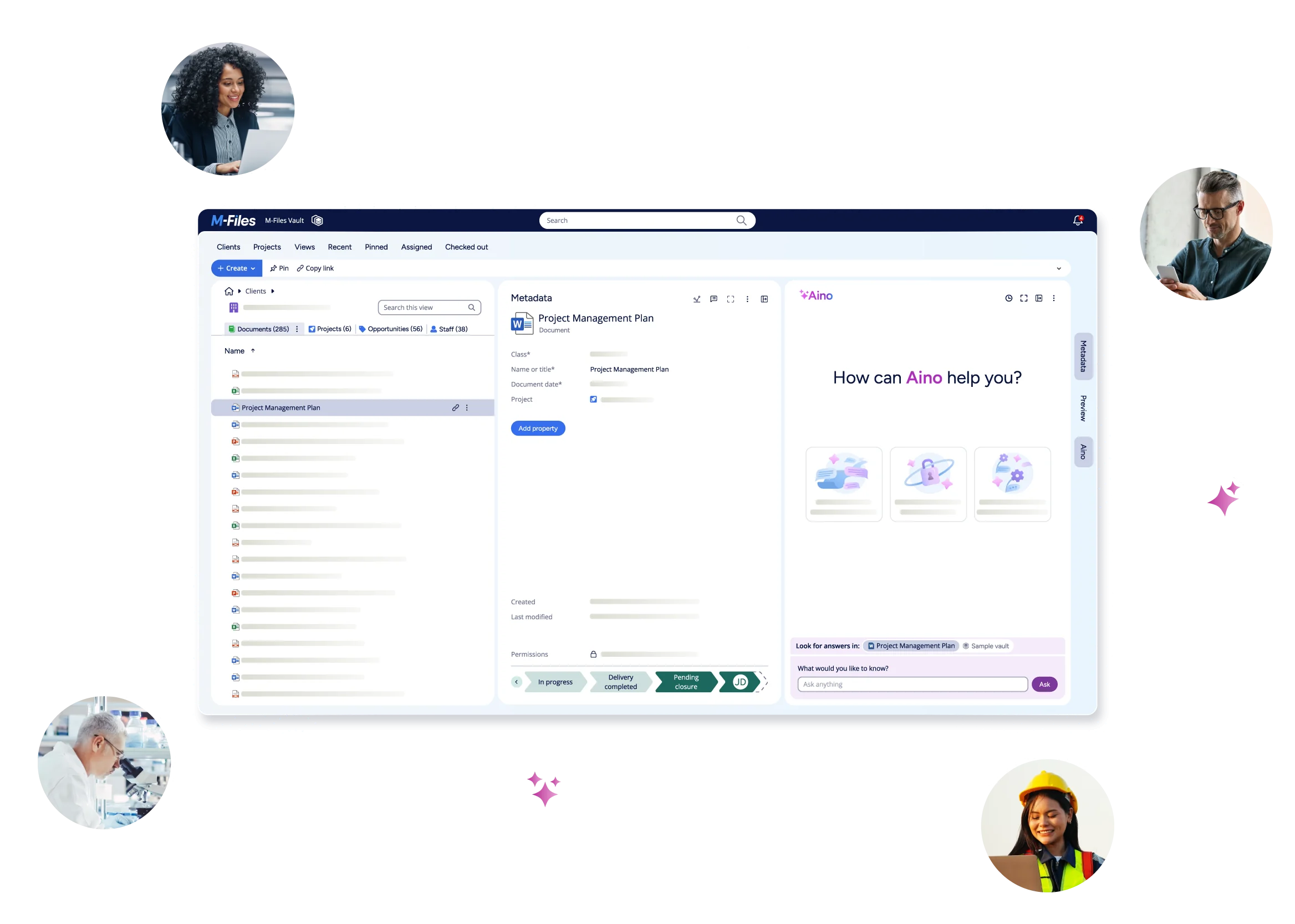
This Context-First approach fundamentally changes how employees interact with information. Rather than asking where a document is stored, users simply access the client, policy, claim, or business process they are working on and immediately see the information that matters. Relationships between documents become visible. Governance follows information automatically. Workflows operate with greater consistency because everyone is working from the same trusted source of truth.
The impact extends well beyond productivity. Context improves collaboration because teams share a common view of information regardless of where it originated. It strengthens governance because approvals, permissions, and lifecycle policies remain connected to the information itself. Most importantly, it provides AI with the business context needed to generate more reliable, explainable, and trustworthy outcomes.
The objective is not simply to improve document management. It is to eliminate operational friction by ensuring information is always connected to the people, processes, and decisions that depend on it.
Building the Foundation for the Next Generation of Insurance
The insurance industry has entered a period where information has become one of its most valuable strategic assets. Organizations that continue to treat documents as static files will find it increasingly difficult to keep pace with growing regulatory expectations, expanding customer demands, and the accelerating adoption of AI. Those that build a trusted information foundation will be better positioned to adapt, innovate, and compete.
Continuous audit readiness is one outcome of that transformation. Faster underwriting, more efficient claims handling, improved collaboration, stronger governance, and trusted AI are others. They all depend on the same principle: information should always retain the business context that gives it meaning.
The insurers that succeed over the next decade will not necessarily be those that adopt AI first. They will be the organizations that ensure AI has access to trusted, governed, and contextualized information from the very beginning. In that environment, audit readiness becomes more than evidence of regulatory compliance. It becomes evidence that the organization has built the operational foundation required to scale innovation with confidence.
Assess Your Insurance Audit Readiness
Every insurer has opportunities to reduce operational friction and strengthen the way information flows across the business.
Our Insurance Audit Readiness Assessment helps insurance leaders evaluate document governance, traceability, workflow visibility, and operational readiness across underwriting, claims, compliance, and policy operations. By identifying potential gaps before they become business risks, organizations can take practical steps toward improving compliance, operational performance, and building a stronger foundation for trusted AI.
Take the assessment to see where your organization stands today and identify the next steps toward more connected, audit-ready insurance operations.
Latest Articles
Browse Topics
Resources
See M-Files in Action