
Information Governance is the Foundation of AI Readiness

Successful Microsoft 365 Copilot adoption depends on a secure and governed information foundation. Organizations need to identify trusted information, apply the right controls, and ensure AI can access accurate, relevant, and properly governed content.
Industry research and customer conversations show that many organizations’ Microsoft 365 Copilot deployments are taking longer while they evaluate permissions, information governance, and content security readiness. Concerns about Copilot responding based on old information or oversharing are prompting organizations to reevaluate how information is secured, maintained, and shared. Microsoft guidance emphasizes the importance of addressing oversharing, permissions, and information protection as organizations prepare for Copilot adoption.
The concern is understandable, but the issue is often misunderstood. Microsoft 365 Copilot operates within the Microsoft trust boundary and respects existing identity, access, security, and compliance controls. It grounds responses in information the user is authorized to access. That makes governance maturity, sharing practices, content security, and information readiness foundational to successful adoption.
Copilot does not bypass Microsoft security controls. It can reveal where information management practices and access controls need to improve before organizations scale AI.
The Real AI Readiness Challenge Behind Copilot Oversharing
For years, organizations have accumulated content across SharePoint, Teams, OneDrive, file shares, email, and business applications. Massive amounts of content often comes with broad sharing permissions, inconsistent access controls, outdated documents, duplicates, missing ownership, anonymous links, and information stored without appropriate business classification.
Before generative AI, many of these issues were obscured by fragmented repositories and limited search experiences. Natural-language access with Copilot changes the equation. When people can ask Copilot a question instead of browsing folders, information that was difficult to find can become easier to discover and use, but sometimes this information wasn’t meant to be discovered as it was not properly managed to begin with.
Copilot is prompting organizations to confront years of accumulated content and uneven governance practices. The strategic issue is not just outdated information or oversharing. It is whether information management practices are mature enough to support AI at scale.
AI Readiness Starts with Information Governance
Many organizations approach AI readiness as a technology deployment project. In practice, success depends on more than permissions. Organizations need clear ownership, information controls, and processes to ensure important information remains accurate, current, and properly managed.
Microsoft guidance frames oversharing remediation, enforceable guardrails, and regulatory requirements as core parts of a secure and governed Copilot foundation. It also points organizations to Microsoft Purview and SharePoint Advanced Management to assess oversharing risks and take corrective action.
The goal is not to govern every document in the same way. The priority is to identify high-value and high-risk information and apply the appropriate controls. Contracts, quality records, client documentation, standard operating procedures, engineering documents, and regulated content often require stronger ownership, protection, and lifecycle management than general collaboration content.
“AI readiness is ultimately information readiness. Organizations that invest in document management best practices to manage governance, permissions, content quality and freshness are better positioned to deliver trusted AI experiences at scale.”
Ian Story, Principal Architect, OneDrive & SharePoint, Microsoft
Why Permissions Alone Are Not Enough
Permissions determine what users can access. Business context helps organizations determine what information should be trusted, protected, retained, and surfaced for AI-driven work by clarifying its purpose, ownership, and business relevance.
A contract, quality record, customer file, engineering document, or regulatory submission carries business meaning that a folder path alone cannot express. Connecting content to the processes, obligations, and records it supports enables more accurate classification, retention, review, and access decisions.
This additional context helps ensure AI is grounded in information that is relevant, reliable, and aligned with business requirements.
How Microsoft and M-Files Work Together
Microsoft provides the trusted foundation for collaboration, content security, governance, compliance, and AI through Microsoft 365, SharePoint, Microsoft Purview, Microsoft Defender, and Microsoft 365 Copilot. Microsoft's governance guidance recommends identifying potentially overshared data, remediating access issues, applying guardrails, and maintaining regulatory and compliance controls.
M-Files extends Microsoft 365 with intelligent document management capabilities, helping organizations manage important business information through metadata, workflow automation, records management, and information controls.
This complementary approach helps organizations strengthen AI readiness while continuing to leverage Microsoft-native security, compliance, collaboration, and AI capabilities. For customers using Microsoft 365 Storage (SharePoint Embedded), content remains within the customer's Microsoft 365 environment while M-Files provides metadata, workflows, permissions, and governance controls.
To strengthen AI readiness and prepare for agent readiness, M-Files can support:
- Metadata-driven classification for strategic business content
- Context-aware permissions and access decisions
- Clear accountability for business information
- Document workflow automation for reviews, approvals, and governance controls
- Records management and lifecycle controls
- Relationships between documents and the customers, projects, contracts, and processes they support
Organizations that establish clear accountability, information controls, and content quality standards today will be better prepared for tomorrow's AI agents and experiences. As AI gains broader access to enterprise information, success increasingly depends on whether that information is accurate, current, appropriately secured, and connected to the business processes it supports.
Agent readiness builds on AI readiness. Before organizations can safely deploy AI agents that recommend actions, automate work, or participate in business processes, they need trusted, governed, and context-rich information to be provided to the AI that powers these agents.
AI and Agent Readiness Checklist
-
Review permissions and sharing controls
Examine access across SharePoint, Teams, OneDrive, and other Microsoft 365 locations. Identify broadly shared sites, anonymous links, outdated groups, and content that is available to more people than the business requires. Organizations using SharePoint Advanced Management can leverage Microsoft tools to assess and remediate oversharing risks before expanding Copilot adoption.
-
Identify sensitive and business-critical content
Inventory the content that carries the greatest business value or risk, including contracts, customer records, financial information, intellectual property, quality records, engineering documents, standard operating procedures, and regulated content. Not all content needs the same level of information governance.
-
Connect information to business processes
Define what the content is, why it matters, who owns it, which business process it supports, and which policies apply. Connecting information to business processes improves discoverability, accountability, and AI readiness.
-
Strengthen lifecycle management and controls
Apply metadata-driven classification, lifecycle management, retention, approval controls, auditability, and periodic access reviews. Effective AI governance is continuous. It should account for content creation, use, review, disposition, and changes in ownership or sensitivity.
-
Validate the foundation before scaling AI
Test representative Copilot use cases with security, governance, legal, compliance, and business stakeholders. Confirm that permissions behave as expected, sensitive content is protected, and trusted information can be readily identified.
The Goal Is Not Less AI. It Is Better Governed AI.
As organizations move from AI experimentation to AI at scale, success increasingly depends on the quality, security, and governance of the information that powers those experiences.
Microsoft provides the trusted foundation for identity, security, compliance, collaboration, and AI. M-Files extends that foundation by helping organizations establish ownership, automate information controls, and manage content throughout its lifecycle.
Trusted AI depends on information that is accurate, well-managed, appropriately secured, and relevant to the work being performed. Organizations that strengthen these foundations today will be better positioned to accelerate Microsoft 365 Copilot adoption, support AI agents, and realize greater value from their Microsoft investments.
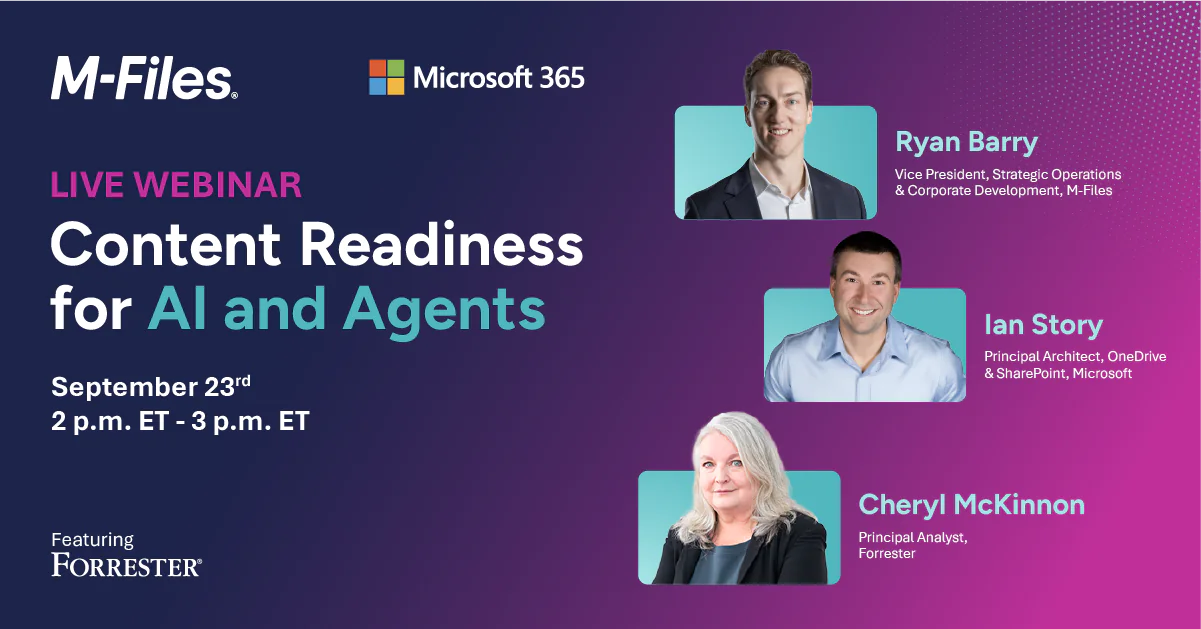
Webinar
Assess Your AI and Agent Readiness
Discover how M-Files helps organizations strengthen AI readiness through better information quality, accountability, and lifecycle management.
Latest Articles
Browse Topics
Resources
See M-Files in Action