

AI Content Governance for Copilot and AI Agents
AI Readiness and Content Governance: What to Expect from the Forrester + Microsoft Webinar

On-Demand Webinar
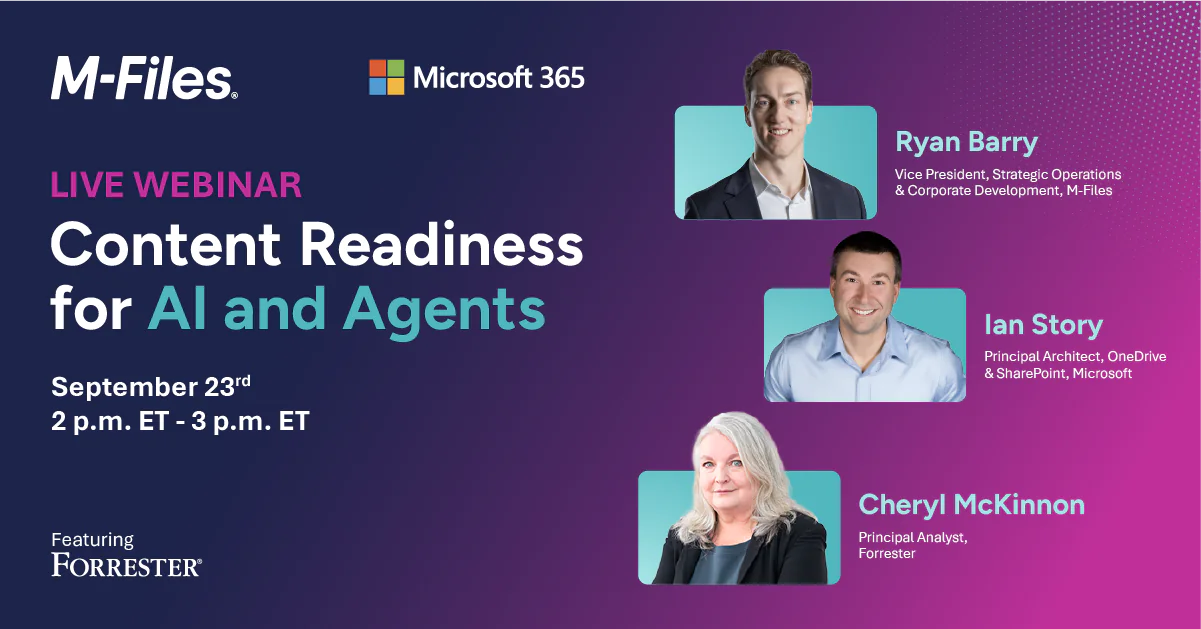
Is Your Content Ready for AI and Agents?
Join Forrester, Microsoft, and M-Files to discover why trusted AI starts with strategic business content and how governance, ownership, and content readiness prepare information for Copilot, AI agents, and agentic workflows.
Trusted AI starts with trusted business content.
Organizations are moving quickly from AI assistants that summarize information to AI agents that can take action, automate tasks, and participate in business processes. As that shift accelerates, a more fundamental question is emerging:
Is your content actually ready for AI?
Many organizations have invested in Microsoft 365 Copilot and broader AI initiatives. Yet trusted AI is not primarily a technology problem. It is an information problem.
AI outcomes depend on the quality, governance, accessibility, and context of the information guiding them. This becomes even more important as organizations move from assistants that help people complete tasks to agents that can execute workflows and support business processes with greater autonomy.
Trusted AI starts with trusted business content. Organizations need confidence that the information guiding AI answers and actions is accurate, current, governed, appropriately accessible, and connected to the work it supports. Without that foundation, AI can amplify existing information problems, increasing the risk of inaccurate outputs, inappropriate access, and poor business decisions.
To explore this challenge, M-Files is bringing together experts from Forrester, Microsoft, and M-Files for an upcoming webinar.
Featuring:
- Cheryl McKinnon, Principal Analyst, Forrester
- Ian Story, Principal Architect, OneDrive & SharePoint, Microsoft
- Ryan Barry, SVP, Finance & Strategic Operations, M-Files
Why Content Readiness Matters Now
The conversation around AI is rapidly evolving. Organizations are no longer evaluating AI solely as a productivity tool. They are moving from AI assistants that summarize, draft, and retrieve information toward AI agents and agentic workflows that can perform tasks, advance processes, and act on information.
That creates a new challenge.
Agents do not simply retrieve information. They act on it.
As AI becomes more autonomous, the quality, governance, and context of information become increasingly important. Organizations need confidence that the information guiding AI actions is accurate, governed, and connected to the business processes it supports. Clear ownership, appropriate permissions, lifecycle controls, and process awareness help ensure that AI operates on information the organization can trust.
AI readiness is therefore not primarily a technology initiative. It is an information readiness and governance initiative.
What Makes Content AI-Ready?
Not all content carries the same business value, risk, or AI impact. Organizations do not need to govern every document in the same way. They should invest more heavily in the information that has the greatest influence on business outcomes, compliance, governance, risk, and AI effectiveness.
This is strategic business content.
Strategic business content supports critical operations, decisions, customer outcomes, regulated activities, and high-consequence processes. It often includes:
- Contracts
- Customer documentation
- Quality records
- Standard operating procedures
- Engineering documentation
- Regulated records
These information assets typically require greater business context, ownership, governance, lifecycle management, and control than everyday collaboration content. Their value comes not only from what the documents contain, but also from how they relate to customers, contracts, projects, suppliers, assets, approvals, and business processes.
AI-ready content is more than searchable content. It is:
- Trusted and authoritative
- Governed and permission-aware
- Connected to business processes
- Rich in metadata and business context
- Assigned clear ownership
- Managed throughout its lifecycle
- Appropriate for AI consumption and automation
By focusing first on strategic business content, organizations can direct their investment toward the information where stronger governance and context will have the greatest impact.
The Microsoft Trust Boundary
Microsoft provides a trusted AI foundation through Microsoft 365, Copilot, SharePoint, SharePoint Embedded, Purview, and its security, compliance, governance, and identity services.
Together, these capabilities create a Microsoft trust boundary in which organizations can innovate with AI while maintaining control, governance, compliance, security, and ownership of their information. This foundation helps organizations make information available to Copilot and AI agents without separating AI adoption from the policies and controls required to manage business risk.
The challenge is ensuring that strategic business content from across the organization can participate in this trusted environment with the context and controls it requires.
The Role of Business Context in AI Success
Content alone rarely tells the whole story.
A contract, for example, becomes significantly more useful when AI understands the customer relationship it supports, the responsible business owner, its position in an approval workflow, its lifecycle status, its retention requirements, and the processes connected to it.
This is where business context becomes critical.
M-Files extends the Microsoft trust boundary for strategic business content by adding business context, governance, ownership, lifecycle controls, workflows, and intelligence. It helps organizations bring strategically important information into the Microsoft environment while preserving the meaning and controls required to use that information responsibly.
By connecting documents to customers, contracts, projects, suppliers, assets, approvals, and business processes, M-Files helps AI understand not only what a document says, but also why it matters and how it relates to the work around it.
Microsoft provides the trusted AI foundation. M-Files helps make strategic business content agent-ready within that foundation.
Work IQ Shows What Happened. Business Context Explains Why
Microsoft Work IQ helps organizations understand what work happened across meetings, emails, conversations, and documents.
Strategic business content provides the business context that explains why that work matters. It connects activity to the customers, contracts, projects, suppliers, assets, approvals, and processes that shape business outcomes.
Together, work activity and business context help organizations understand both the work performed and the business outcomes it supports. This gives people and AI agents a more complete foundation for interpreting information, supporting decisions, and participating in business processes.
What You'll Learn During the Webinar
During the session, attendees will explore:
- Why trusted AI starts with trusted business content
- Why trusted AI is primarily an information challenge, not simply a technology challenge
- How the shift from AI assistants to AI agents changes information requirements
- How collaboration-focused content strategies can create new AI risks
- Why strategic business content has the greatest impact on business outcomes, risk, and AI effectiveness
- What makes information truly agent-ready for Microsoft Copilot and AI agents
- How Microsoft’s trust boundary and M-Files business context work together to support trusted AI outcomes
- How organizations can close the AI readiness gap while maximizing their Microsoft investments
- The connection between business context, governance, and trusted AI outcomes
You will also hear perspectives from Forrester, Microsoft, and M-Files on how organizations should approach content readiness and governance as AI becomes more autonomous.
Preparing for the Agentic Future
The next phase of enterprise AI will not be defined by who has access to the most AI tools. It will be defined by who can provide those tools with the most trusted, governed, and context-rich information.
Organizations do not need to transform every document. They should begin by identifying strategic business content: the information with the greatest influence on business value, operational continuity, compliance, risk, and AI effectiveness.
They can then assess its readiness, apply governance, business context, ownership, and lifecycle controls where they matter most, and bring that strategic content into the Microsoft trust boundary. This gives Copilot and AI agents access to trusted information that is connected to the business processes it supports.
Trusted AI starts with trusted business content.
Join Us
If you're responsible for AI strategy, enterprise architecture, information governance, Microsoft 365, or digital transformation initiatives, this webinar will provide practical guidance for preparing your content foundation for the next generation of AI.
Latest Articles
Browse Topics
Resources
See M-Files in Action