
How Microsoft and M-Files Transform Document Management


The future of document management
M-Files and Microsoft are using the power of AI to transform fragmented document systems with a secure and unified intelligent collaboration solution.
Today’s digital-first workplace makes document management not just a technical concern, but a strategic imperative. From productivity and compliance to employee engagement, the systems we use to store, share and secure content shape the rhythm of modern enterprise life. Yet many organizations still rely on a patchwork of legacy tools, cloud platforms and departmental systems. The result? A tangled web of “content chaos” where vital information is scattered, siloed and often out of reach.
Disconnected systems – email servers, shared drives, customer relationship management platforms, enterprise resource planning solutions – rarely speak the same language. Employees spend time hunting for documents, toggling between apps, or recreating content that already exists. This inefficiency doesn’t just sap productivity, it introduces compliance risks, especially in regulated sectors like healthcare, finance and manufacturing.
Version confusion, duplicated efforts and inconsistent metadata tagging erode trust in organizational data. When employees aren’t sure if a document is accurate or current, they hesitate to act. Meanwhile, the constant switching between tools creates cognitive overload, fueling change fatigue and resistance to transformation.
Microsoft SharePoint has long been a cornerstone of enterprise content management. It offers centralized storage, real-time collaboration, granular access controls and seamless collaboration with Microsoft 365 tools like Teams and OneDrive. It also enables AI-powered features like Microsoft Copilot to interact with stored content.
But SharePoint isn’t perfect. Version control can become murky when documents are duplicated across team channels and personal folders. Metadata often requires manual setup, limiting automation. And while enterprise search is powerful, it’s not always intuitive, so users often struggle to locate documents unless they know the exact name or path.
Governance is another challenge. Without a unified strategy, organizations face permission sprawl, accidental exposure of sensitive content and difficulty enforcing retention policies. Audits become complex, so the risk of non-compliance grows.
There’s also the human element to consider. Poor user experience in document systems leads to disengagement. When tools are clunky or inconsistent, employees create their own workarounds – personal folder structures, unauthorized cloud services, informal sharing. This “shadow IT” undermines governance and introduces security vulnerabilities.
Change fatigue is real. When new tools are rolled out without clear benefits or adequate support, employees resist. They fear losing control over their workflows, struggle with steep learning curves, and question the motives behind transformation. Without thoughtful implementation, even the most promising technologies can fall flat.
Enter M-Files, a leader in AI-powered document management, and strategic partner of Microsoft. This collaboration enables seamless connectivity between M-Files and Microsoft 365 via SharePoint Embedded – an API-only, scalable content repository that powers modern Microsoft experiences like Loop and Copilot Pages.
This partnership tackles long-standing pain points in document management: fragmented governance, poor content quality and siloed environments. By centralizing content and embedding intelligence into everyday workflows, M-Files and Microsoft 365 empower organizations to automate metadata tagging and document classification, as well as improve their decision-making with AI-curated insights and strengthen compliance with unified governance via Microsoft Purview. And by leveraging existing Microsoft 365 infrastructure, they are able to maximize their return on investment.
M-Files now allows organizations to store selected content directly within the Microsoft 365 tenant, eliminating duplication and enabling seamless access through familiar apps like Teams, Outlook, and Copilot. This native connection supports co-authoring, real-time collaboration and AI-driven workflows – all while maintaining strict compliance through Microsoft Purview.
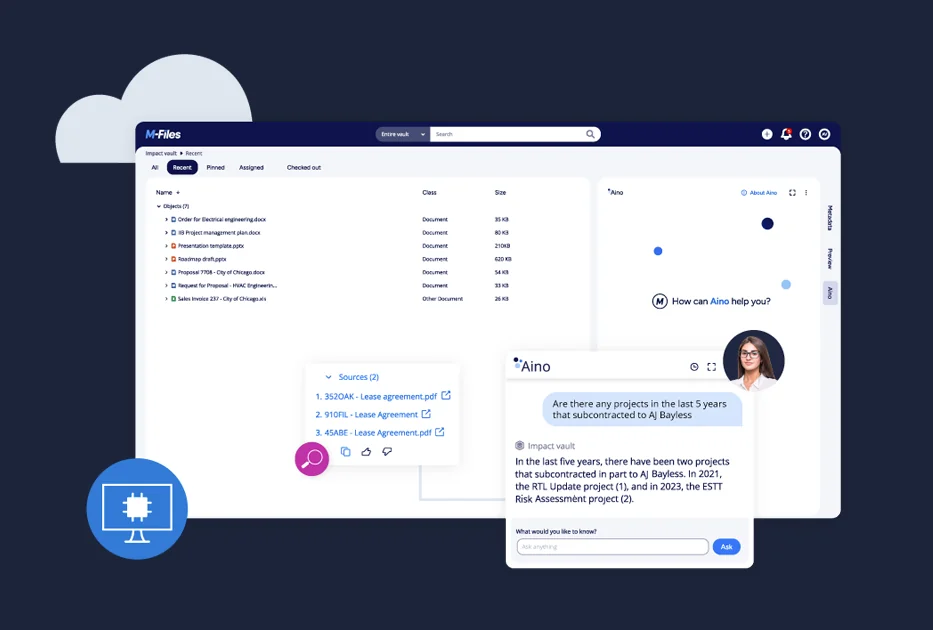
At the heart of M-Files is Aino, a generative AI assistant that enables conversational interactions with enterprise content. Aino can classify documents, extract metadata, generate summaries and surface context-aware insights. Paired with Copilot, it creates a powerful ecosystem where AI agents analyze documents with full context and compliance.
For organizations invested in Microsoft 365, M-Files isn’t just compatible, it’s essential. It brings order, automation and control to business content, while enabling collaboration that is secure, scalable and intelligent. Whether managing technical specifications, client deliverables or compliance records, M-Files ensures that content is organized, accessible and actionable – right where teams already work.
This unified solution marks a departure from legacy systems. It’s not just about storing documents – it’s about transforming how we interact with them. With M-Files and Microsoft 365, the future of document management is intelligent, integrated and ready for what’s next.
Explore the M-Files and Microsoft partnership to see how AI-driven document management transforms your business.
Latest Articles


Browse Topics
Resources
Try M-Files Free for 30 Days!
Explore the GenAI capabilities of M-Files Aino, enhance collaboration with colleagues, automate workflows, and unlock endless possibilities.