
What Is Contract Lifecycle Management?
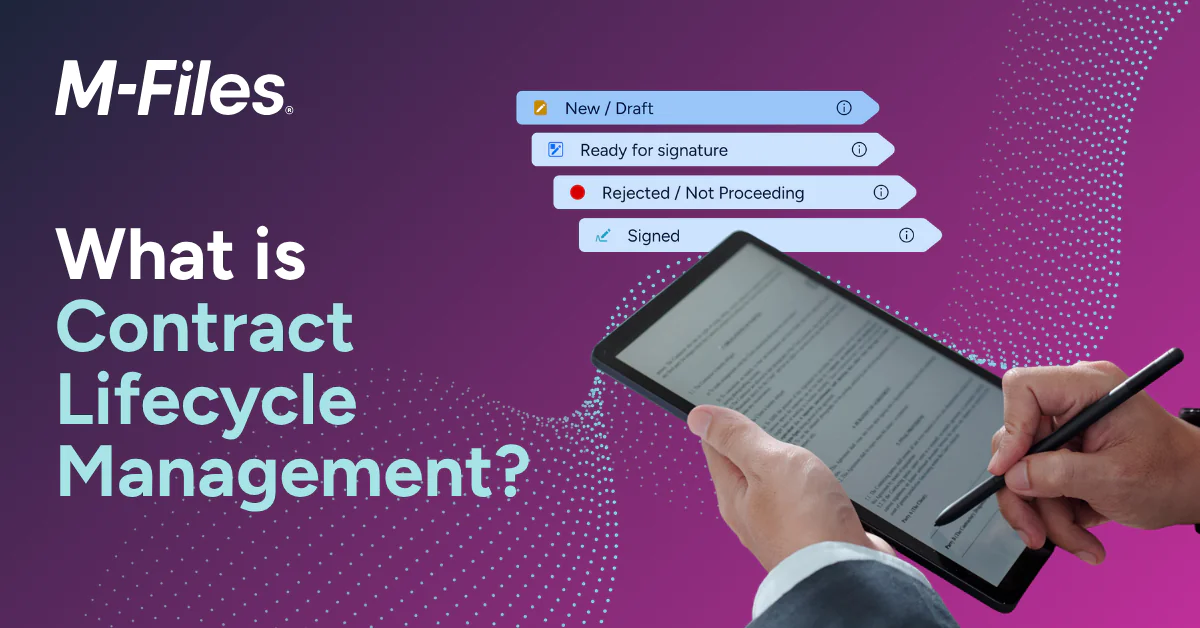

A Context-First Definition for the AI Era
Contract Lifecycle Management (CLM) is everywhere in the enterprise technology conversation, and yet it remains one of the most misunderstood categories in modern business infrastructure.
Most vendors define CLM in operational terms. They describe it as software that manages contracts from drafting and negotiation through approval, execution, storage, and renewal. That explanation is not incorrect. It simply stops too soon.
CLM is the process of managing contracts across their lifecycle, from creation and negotiation through approval, execution, storage, renewal, and compliance oversight.
It defines the movement of documents, but it does not define the governance of agreements. It also does not define the performance implications of contracts across the enterprise.
In today’s environment, shaped by AI acceleration, regulatory complexity, distributed teams, and expanding digital ecosystems, Contract Lifecycle Management must be understood as something far more foundational.
CLM is no longer about managing documents. It is about operationalizing contractual meaning. And that requires architecture, not just automation.
Why the Traditional Definition Falls Short
Historically, contract management problems were visible and tangible. Paper contracts were misplaced, email threads caused version confusion, and approvals stalled in inboxes. Legal teams became bottlenecks because routing lacked structure.
The first generation of CLM tools addressed these visible inefficiencies. They digitized workflows, centralized storage, and improved process transparency, resulting in measurable gains in cycle time and administrative efficiency.
But as enterprises matured digitally, a deeper issue emerged.
Even with automation in place, contracts remained fundamentally file-centric. They were stored as isolated artifacts in repositories, often separate from the systems that governed customers, suppliers, projects, and compliance obligations.
The contract file moved more efficiently, but its business context remained disconnected.
This is the gap between digitization and operationalization. Digitization reduces friction in document movement, while operationalization eliminates friction in business understanding. The former improves workflow, while the latter improves performance.
Contracts Are Infrastructure, Not Paperwork
To understand why CLM must evolve, it is important to recognize what contracts truly represent.
Contracts are not administrative documents created at the edges of the business. They are structural agreements that define how the enterprise operates. Every commercial relationship, supplier engagement, employment agreement, partnership arrangement, or regulatory commitment is anchored in a contract.
Contracts allocate risk, define revenue recognition and payment obligations, establish service levels and delivery expectations, encode compliance requirements, formalize intellectual property ownership, and determine renewal timing and termination conditions.
In other words, contracts are governance artifacts.
When governance artifacts are treated as files, meaning becomes trapped inside text. And when meaning is trapped, organizations experience operational friction.
This friction manifests quietly but pervasively. Legal teams chase updates and clarify terms. Procurement tracks renewal exposure in spreadsheets. Sales negotiates without full visibility into prior commitments. Finance worries about liability clauses buried deep in documents. IT struggles to maintain consistent access control across disconnected repositories.
This friction is not dramatic, but it is cumulative. In high-velocity enterprises, cumulative friction limits performance.
The AI Inflection Point
If the digitization gap revealed structural weaknesses, AI has amplified them.
The current wave of AI capabilities has significantly increased expectations around insight and automation. Boards want visibility into risk exposure across contract portfolios. Legal teams want clause deviation analysis. Procurement wants supplier concentration metrics. Sales wants instant clarity on contractual obligations before negotiating renewals.
AI appears to promise these capabilities, but it does not compensate for fragmented architecture.
If contracts are inconsistently classified, lifecycle states are unclear, renewal timing is buried in free text rather than structured metadata, and permissions are manually assigned across folders, AI outputs may appear impressive but lack defensibility.
AI can summarize what it sees, but it cannot fix what is structurally missing.
Trustworthy AI requires governed context, and governed context requires architectural discipline. This is why the traditional definition of CLM is insufficient for the AI era.
A Context-First Definition of CLM
Modern Contract Lifecycle Management should be defined as the governance and orchestration of contract content, lifecycle workflow, identity controls, and business relationships within a unified, metadata-driven document management system.
This definition reframes CLM from workflow tooling to enterprise infrastructure.
It emphasizes that contracts must be connected to the business entities they govern, structured through metadata that reflects lifecycle state, governed through permission-aware access controls, and embedded inside a unified system of record.
This is the essence of Context-First Document Management.
Rather than organizing contracts by where they are stored, a context-first architecture organizes them by what they are and how they relate to the business. That shift changes everything.
The Three Interlocking Dimensions of Modern CLM
To operate as infrastructure rather than tooling, CLM must function across three tightly connected dimensions: process governance, content governance, and portfolio governance.
Process governance focuses on predictability and defensibility. CLM governs how contracts move through lifecycle stages such as drafting, review, negotiation, approval, activation, renewal, amendment, and expiration. Governance must be metadata-driven rather than user-driven to reduce variance and improve auditability.
Content governance focuses on structure over storage. It requires consistent classification, structured relationships, and permission-aware access models. In a context-first system, contracts are connected to business objects such as customers, suppliers, projects, and assets, with permissions that inherit from these relationships and adapt automatically as roles change.
Portfolio governance focuses on enterprise visibility. It enables organizations to answer critical questions in real time, such as how many active contracts exist with a supplier, what renewal exposure looks like, and where contractual risk is concentrated.
Together, these dimensions transform CLM from a repository into a strategic management layer.
Why Microsoft-Native Architecture Is Strategic
Most enterprises operate within Microsoft 365 as their digital backbone. Collaboration, communication, document authoring, and AI services are increasingly centralized there.
Introducing a CLM platform outside this ecosystem creates fragmentation, including separate identity environments, duplicated compliance policies, and inconsistent governance.
A Microsoft-native approach eliminates this friction.
When CLM operates within Microsoft Teams, SharePoint, Outlook, and aligns with Microsoft Entra ID and Microsoft Purview, governance becomes embedded within the digital workplace. Users stay in familiar tools, identity remains consistent, and compliance extends uniformly.
The goal is not to replace Microsoft 365, but to elevate it into a governed contract system of record.
From Operational Friction to Performance Advantage
The ultimate purpose of modern CLM is not administrative efficiency. It is performance enablement.
When contracts are connected, governed, and lifecycle-driven within a unified document management system, organizations gain clarity. Renewal exposure becomes visible before it becomes urgent. Obligations are traceable without manual investigation. Access adapts automatically, and AI operates on structured, trusted information.
This clarity reduces operational friction.
Over time, reduced friction compounds into a performance advantage through faster decisions, stronger compliance, improved cross-functional alignment, and AI that can be trusted.
The Future of Contract Lifecycle Management
As enterprises move deeper into an AI-accelerated decade, CLM will increasingly be evaluated not by how quickly it routes documents, but by how effectively it operationalizes contractual meaning.
The future of CLM is context-first rather than file-centric, permission-aware rather than manually governed, lifecycle-driven rather than storage-focused, Microsoft-native rather than siloed, and AI-grounded rather than experimental.
Organizations that embrace this shift will not simply manage contracts more efficiently. They will govern them strategically.
And in the modern enterprise, governance is performance.
Latest Articles

Browse Topics
Resources
See M-Files in Action