
Tax Document Management Software Is Not Solving the Real Problem in Advisory Firms

Why engagement architecture, not file storage, determines performance
Tax document management software has become standard across accounting and advisory firms.
Files are centralized. Search is faster. Version history is tracked. Access can be controlled.
And yet engagement execution still feels more complex than it should.
Managers spend valuable time chasing status updates. Associates lose billable hours searching for the latest version of workpapers. Partners lack real time visibility into engagement health. Reviews extend longer than expected. Approvals stall in inboxes.
If document management software is already in place, why does operational friction persist?
Because the real constraint in modern tax advisory firms is not document storage.
It is engagement architecture.
The Limits of Traditional Tax Document Management Software
Most tax document management systems were designed to solve a specific problem. They centralize files so documents can be stored, organized, searched, and retrieved efficiently.
These capabilities are necessary. But they are no longer enough.
Tax advisory firms do not deliver files. They deliver engagements.
An engagement is not simply a collection of documents. It includes tasks, reviews, approvals, compliance requirements, deadlines, and clearly defined responsibilities across multiple roles. It evolves over time and requires coordination under pressure.
When documents live in one system, tasks in another, review comments in email, and approvals in inboxes, professionals are forced to reconstruct context manually every day.
That reconstruction work is invisible. It is rarely measured. But it consumes time and energy.
This is operational friction.
The Hidden Cost of File Centric Architecture
A folder can store a workpaper. It cannot tell you whether that workpaper is under review, whether it has been formally approved, or who owns the next step.
It cannot show which phase of the engagement the document supports or how it connects to prior year work. It cannot surface emerging risk signals or reveal bottlenecks before they become urgent.
In many firms, that information lives across email threads, spreadsheet trackers, practice management systems, and institutional memory.
The document management system becomes a digital filing cabinet rather than a true engagement system.
As engagement complexity increases, fragmentation compounds. Review bottlenecks surface late. Approval tracking becomes manual. Version confusion leads to rework. Compliance controls depend heavily on professional discipline.
Over time, this structural fragmentation erodes margin, slows delivery, and increases risk exposure.
What Operational Friction Looks Like in Tax Advisory
Operational friction appears gradually. It is not one catastrophic failure but a pattern of small inefficiencies that accumulate.
Managers spend mornings following up on reviews. Associates search across shared drives to confirm they are working from the correct file. Partners request status updates that require manual reporting. Approvals rely on email threads rather than structured tracking.
None of these issues seem dramatic on their own. Together, they create a measurable performance barrier.
The firm feels busy but not fluid. Productive but not optimized. Capable but constrained.
Why Modern Tax Engagements Require More Than Storage
Tax advisory work today is highly regulated, deadline sensitive, review intensive, and increasingly advisory driven. Clients expect proactive insight. Regulatory scrutiny continues to increase. AI adoption is accelerating.
Execution is collaborative and iterative. Documents move through drafting, review, revision, approval, and retention. Tasks shift as new information emerges. Risk considerations evolve throughout the engagement lifecycle.
Traditional tax document management software was not designed to model that dynamic complexity. It was built to manage files.
Modern firms need systems that support visibility, coordination, governance, and AI readiness across the entire engagement.
This requires moving beyond file management toward engagement centric delivery.
The Engagement Visibility Gap
Even firms with established tax document management systems often lack unified engagement visibility.
Partners want portfolio level insight into engagement health and pending approvals. Managers want clear progress tracking, review queues, and workload visibility. Associates want prioritized tasks and immediate access to relevant documents without switching between systems.
When this visibility requires manual reporting and coordination, firms operate reactively.
Managers chase updates. Associates chase files. Partners escalate issues late in the cycle.
This is not a talent issue. It is a structural design issue.
The engagement itself is not modeled as a connected system.
From Managing Files to Managing Engagement Context
To eliminate operational friction, firms must reorganize information around the engagement rather than around folders.
When the engagement becomes the organizing unit, documents, tasks, reviews, approvals, and compliance controls are structurally connected. Context is captured once and reused throughout the lifecycle.
Instead of asking professionals to manually assemble status from multiple tools, the system presents a unified engagement view.
This architectural shift is the foundation of M-Files for Tax Advisory.
How M-Files for Tax Advisory Redefines Tax Document Management Software
M-Files for Tax Advisory transforms document management into engagement management.
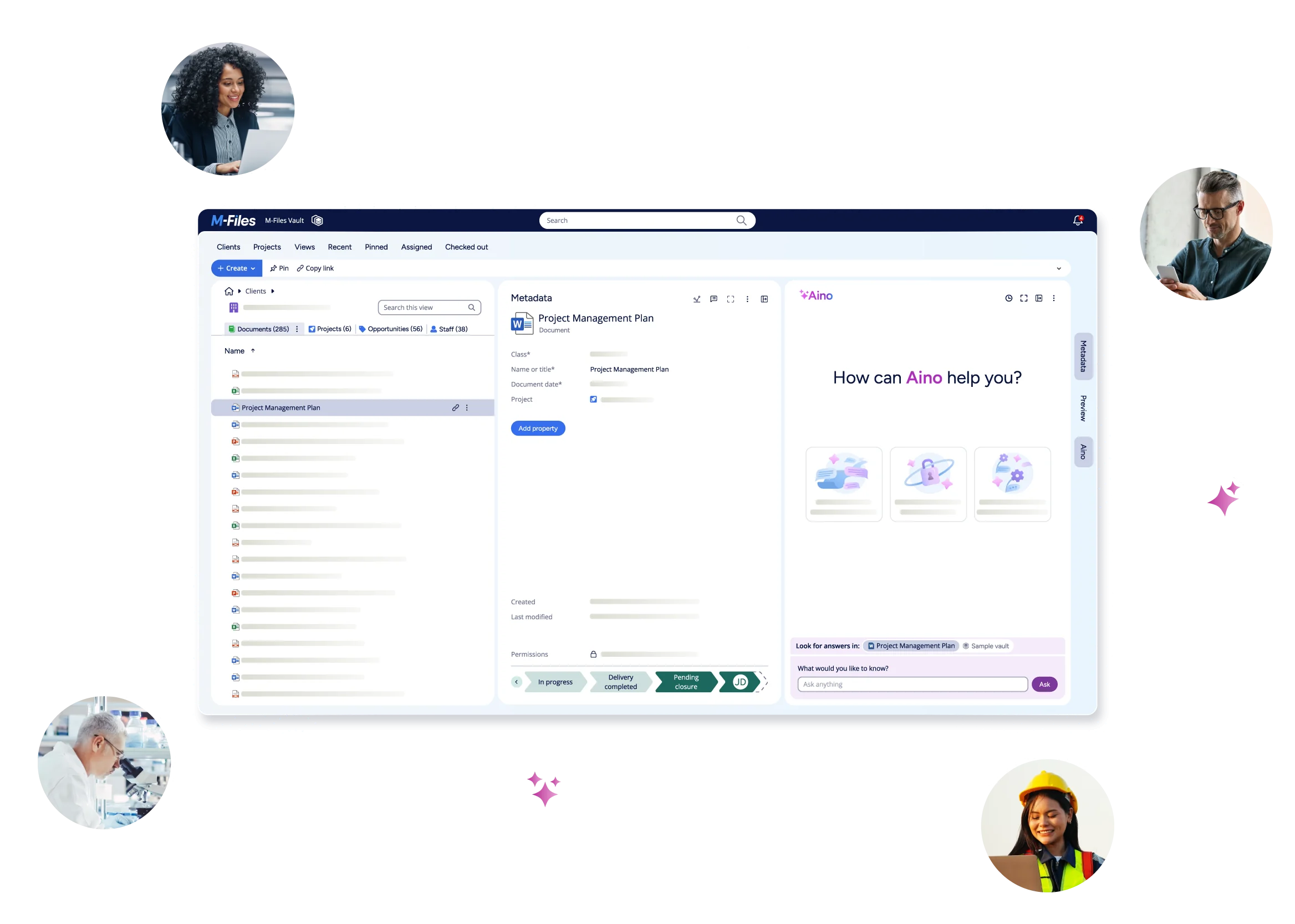
Rather than treating documents as isolated files, it connects documents with tasks, review assignments, approval assignments, dashboards, and governance controls inside structured engagement views.
The engagement becomes the system of record for execution and compliance.
Work is no longer hidden inside folders or inboxes. It becomes visible and coordinated.
A Structured Work Model for Execution
Execution is driven by clearly defined work items.
Tasks manage day to day execution responsibilities. Review assignments coordinate document review in a structured way. Approval assignments formalize sign off.
Ownership, due dates, and status are visible within the engagement context. This reduces status chasing and accelerates review cycles because responsibilities are explicit.
Managers gain clarity. Associates gain direction. Partners gain confidence.
Role Based Engagement Dashboards
Traditional tax document management software focuses on file access. M-Files for Tax Advisory focuses on engagement visibility tailored to each role.
Partners can see engagement health and pending approvals across their portfolio. Managers can monitor progress, review queues, and emerging bottlenecks. Associates can see prioritized tasks and access relevant documents directly within the engagement context.
Instead of switching between systems to assemble a picture of progress, each role works from a structured dashboard aligned to their responsibilities.
Execution becomes transparent rather than reactive.
Governance Without Added Burden
Compliance in tax advisory cannot depend solely on discipline and memory.
M-Files for Tax Advisory embeds permission controls, lifecycle management, version tracking, and audit logging directly into the engagement structure.
Governance operates in the background. Professionals focus on delivering client work while the system enforces consistency and traceability.
This strengthens risk management without increasing administrative overhead.
AI Grounded in Engagement Context
AI in tax advisory is only as effective as the structure beneath it.
When documents, tasks, approvals, and engagement phases are disconnected, AI lacks reliable context. When they are structurally connected, AI can operate within governed relationships.
M-Files for Tax Advisory enables AI to summarize engagement status, surface relevant documents, highlight pending approvals, and suggest next steps within the engagement workspace.
AI becomes more reliable because it understands the engagement, not just the file.
Designed to Enhance Your Existing Systems
M-Files for Tax Advisory enhances Microsoft 365 and integrates with existing firm systems including practice management tools.
It does not require firms to replace their technology stack. Instead, it brings structure and visibility to engagement execution while leveraging existing investments.
This approach reduces disruption and accelerates time to value.
What Changes When Engagement Architecture Improves
When firms move beyond file centric document management and adopt engagement centric architecture, measurable improvements follow.
Review cycles become more predictable because ownership and status are visible. Approval bottlenecks surface earlier. Search time declines because documents are accessed in context. Rework decreases as version confusion is reduced. Portfolio visibility improves at the partner level. Governance becomes consistent rather than manual.
Operational friction declines because coordination is embedded into the system.
Professionals spend less time reconstructing context and more time delivering advisory insight.
The Competitive Reality
If your firm is evaluating tax document management software, storage and search capabilities are no longer differentiators. They are baseline expectations.
The more important question is how your firm structures engagement execution.
Will your system simply store documents, or will it connect documents, tasks, reviews, approvals, governance, and AI into a unified engagement model?
File repositories address yesterday’s problem.
Engagement architecture addresses today’s performance challenges.
The Bottom Line
Tax document management software remains essential. But it is no longer sufficient.
Modern tax advisory firms require engagement clarity. They need structured visibility across documents, tasks, reviews, approvals, governance, and AI.
M-Files for Tax Advisory transforms document management into engagement management, reducing operational friction and strengthening execution control across the firm.
You do not need more folders.
You need engagement architecture.
Ready to Reduce Operational Friction?
See how M-Files for Tax Advisory brings engagement dashboards, tasks, reviews, approvals, and governance into one structured workspace.
Request a demo or schedule a strategy session to evaluate how your engagement architecture supports performance.
Frequently Asked Questions
Latest Articles

Browse Topics
Resources

See M-Files in Action