
How M-Files for Quality Connects Your QMS
How M-Files for Quality Works (And Why It’s Different)

Quality work isn’t broken. It’s disconnected.
Most quality teams aren’t struggling because they lack processes. In fact, they often have well-defined processes for document control, structured workflows for CAPAs and audits, and systems in place for training and compliance. The issue is that these processes rarely operate as a cohesive whole.
A document update doesn’t automatically trigger training. A CAPA isn’t always linked back to the originating issue. Audit evidence is often stored separately from the workflows that created it. So while the individual pieces exist, they don’t function together as a true system, which creates gaps, inefficiencies, and risk.
M-Files for Quality addresses this by bringing everything into a single, structured environment built around context. Instead of managing disconnected processes, organizations gain a unified system where documents, workflows, and records are inherently connected.
A different starting point: organize around what matters
Traditional systems organize information by location, such as folders, repositories, or applications. M-Files takes a fundamentally different approach by organizing information based on what it is and how it relates to other elements of the business.
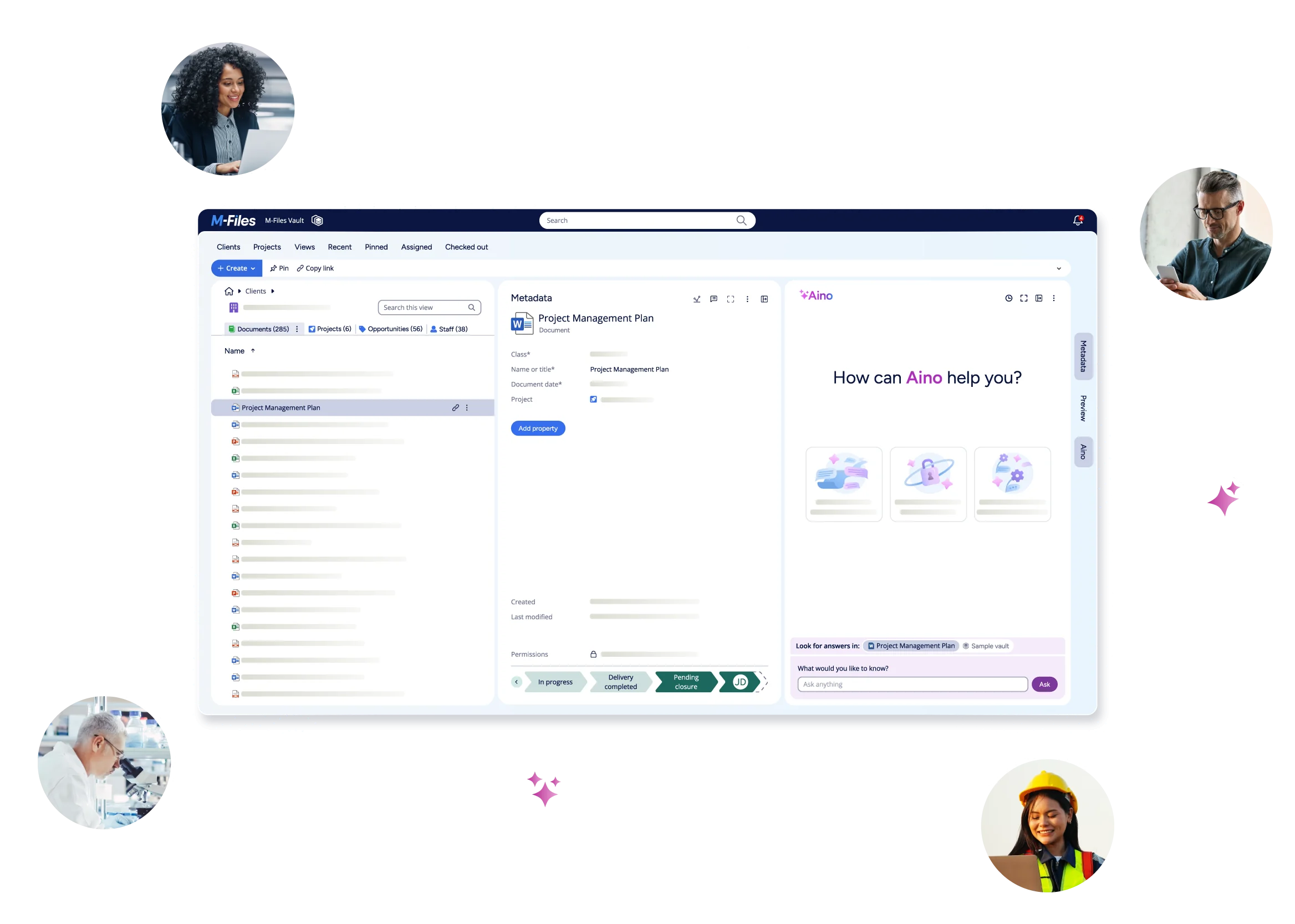
Every piece of quality information, including documents, workflows, and records, is connected through metadata. This means a work instruction is no longer just a standalone file. It is directly linked to the product it applies to, the process it supports, the site where it is used, and the training requirements it triggers.
This structure transforms static information into something dynamic and actionable, ensuring that context is always preserved and accessible.
Controlled documents that actually stay controlled
Document control is foundational to quality, but in many organizations it is also a significant source of risk. M-Files for Quality addresses this with fully governed document management.
Standard operating procedures, policies, and work instructions are version-controlled, routed through automated review and approval workflows, and released with full traceability and audit trails. Access is governed by role, ensuring that operators, engineers, and quality leaders always see exactly what they need and only the current, approved version.
The result is clarity and confidence. There are no duplicate files, no ambiguity, and no confusion over which version is final.
Workflows that don’t rely on manual tracking
Quality processes depend on consistent execution. CAPAs must move from initiation to closure, audits must be planned and documented, and changes must be reviewed, approved, and communicated effectively.
In many organizations, these processes are still tracked manually through spreadsheets or email, which introduces delays and increases the risk of errors. M-Files replaces this with structured, automated workflows that provide clear ownership, visibility, and traceability at every stage.
CAPA and NCR processes follow defined stages, audit workflows connect findings directly to evidence and follow-up actions, and change control processes link updates to documents, training, and downstream activities. Everything happens within a governed system, reducing reliance on manual coordination.
Training that connects to real work
A common gap in quality management is the disconnect between document changes and training. When a procedure is updated, it is often difficult to ensure that everyone who needs to know has acknowledged it.
M-Files solves this by linking training directly to controlled documents. When a document changes, training tasks can be triggered automatically, and completion is tracked and recorded as evidence. Every action is tied back to the original document and workflow, creating a clear and auditable connection between what changed and who was trained.
Audit management without the scramble
Audits are where fragmentation becomes most visible. They require pulling together documentation, evidence, and records, often from multiple systems and teams.
M-Files brings structure to audit management by connecting audit plans, findings, evidence, and corrective actions within a single environment. Because documents, workflows, and records are already governed and connected, much of the required evidence is available before the audit even begins.
This shifts audits from reactive, time-consuming exercises to structured, manageable processes.
Supplier quality in the same system
Quality doesn’t stop at internal processes. It extends across the supplier ecosystem. M-Files includes supplier documentation and quality management within the same environment as internal processes.
Supplier records, documentation, audits, and corrective actions are managed in a unified system, improving traceability and reducing the risk of disconnected or incomplete supplier data.
Built for how teams actually work
One of the biggest barriers to quality system adoption is usability. When systems require teams to leave their everyday tools, adoption suffers.
M-Files is designed to work within Microsoft 365, embedding quality processes into the environments teams already use. Documents and workflows are accessible in familiar tools, collaboration happens naturally across teams, and adoption extends beyond the quality department.
Quality becomes part of daily work, rather than a separate system that teams must navigate.
Governance that runs in the background
A defining characteristic of M-Files for Quality is that governance is built in, not bolted on. Permissions, version control, lifecycle management, and audit trails are applied automatically through metadata and workflows.
Users don’t need to think about compliance at every step. The system enforces it consistently in the background, reducing risk while simplifying the user experience.
The result: a connected quality system
When these capabilities come together, the result is more than a set of features. It is a connected quality system where documents are always current and controlled, workflows are structured and visible, evidence is captured automatically, and teams operate from a shared source of truth.
Quality work becomes predictable, traceable, and scalable, supporting both compliance and operational performance.
The bottom line
M-Files for Quality doesn’t just digitize existing processes. It restructures how quality is executed by connecting everything through context.
This is what enables organizations to reduce operational friction, move faster, lower risk, and scale quality across teams and sites, while building a foundation for trusted, AI-ready processes.
Latest Articles



Browse Topics
Resources

See M-Files in Action