
M-Files for Contracts: Context-First CLM
Introducing M-Files for Contracts
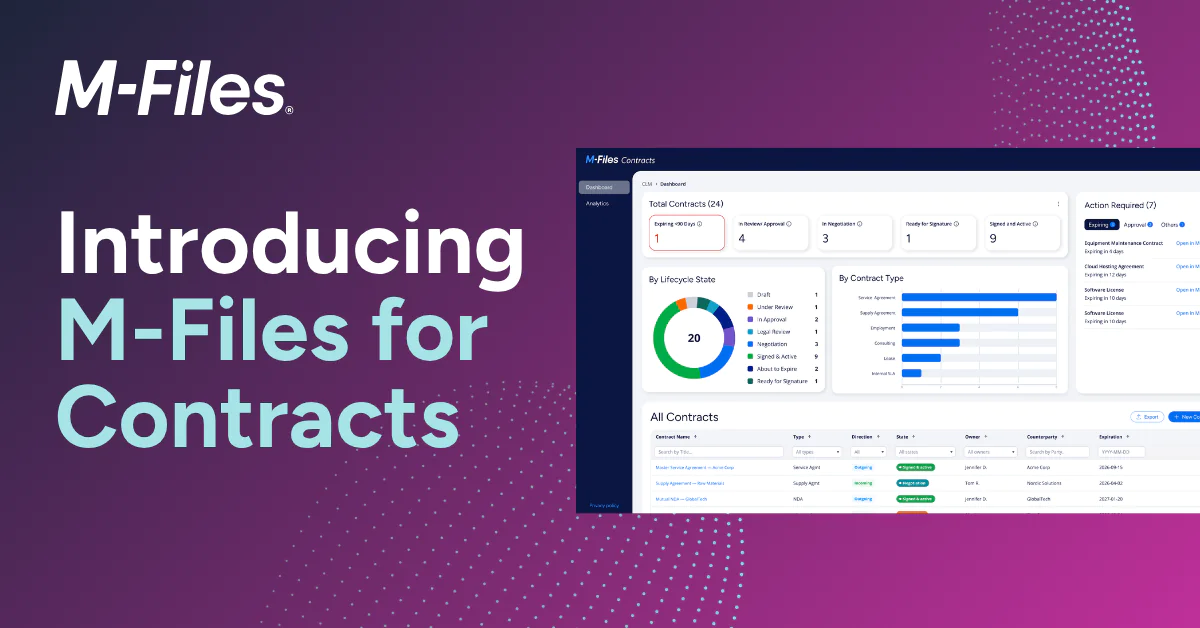

Context-First Contract Lifecycle Management in Action
If modern Contract Lifecycle Management requires context-first architecture, embedded lifecycle governance, Microsoft-native alignment, and AI-ready infrastructure, the natural question becomes: what does that look like in practice?
It looks like M-Files for Contracts.
M-Files for Contracts is not simply another CLM application. It is contract lifecycle governance built on the M-Files Context-First Document Management platform.
This distinction matters.
Rather than layering workflow on top of stored documents, M-Files connects contracts to structured business entities inside a unified document management system. Contracts become governed business assets, embedded within enterprise context.
Built on the Enterprise Knowledge Graph
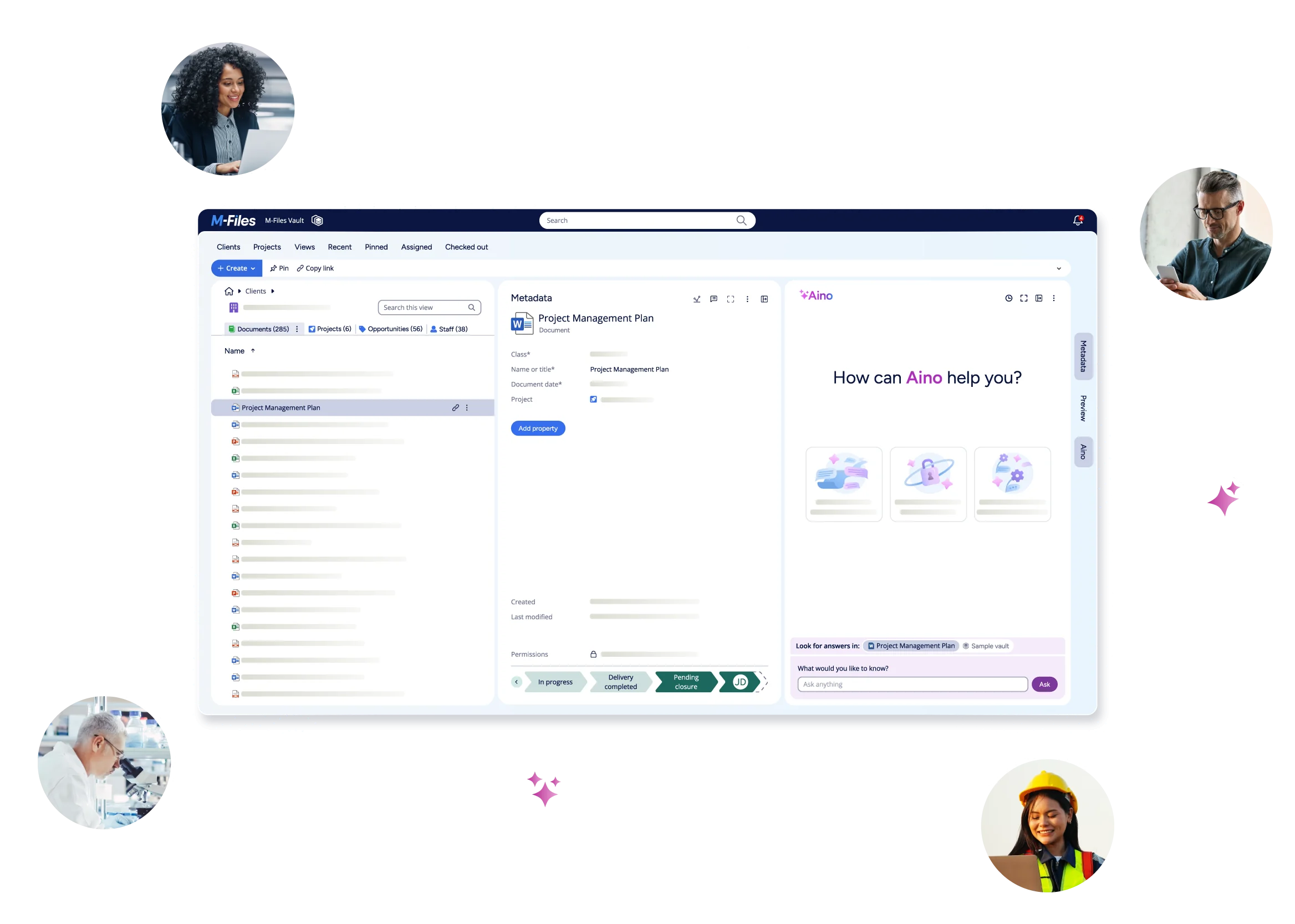
At the foundation of M-Files is the Enterprise Knowledge Graph, a contextual layer that models relationships between contracts and the business entities they govern.
Contracts are connected to customers, suppliers, projects, compliance obligations, and internal stakeholders as structured metadata. Lifecycle state, renewal timing, ownership, and obligations are not implied by folder structures. They are explicitly modeled.
This contextual foundation enables dynamic portfolio visibility, permission inheritance based on business relationships, metadata-driven lifecycle governance, and AI reasoning grounded in structured context.
Without this architecture, lifecycle intelligence remains reactive. With it, governance becomes systemic.
Embedded Lifecycle Intelligence
M-Files for Contracts embeds lifecycle governance directly into the system.
Incoming, outgoing, and internal agreements follow structured, metadata-driven paths. Workflow routing is determined automatically by contract type and direction. Approval histories are preserved as structured data, and renewal timing becomes actionable metadata rather than buried text.
Permissions are inherited from related entities instead of being assigned manually. As roles shift and business relationships evolve, access adapts automatically.
This architecture reduces operational friction across Legal, Procurement, Sales, Finance, and IT. Lifecycle intelligence is not layered on top of storage. It is built into the core.
Native to Microsoft 365
M-Files for Contracts operates natively within Microsoft 365.
Contracts surface directly within Teams, SharePoint, Outlook, Microsoft 365, and Copilot. Identity aligns with Microsoft Entra ID, and governance extends through Microsoft Purview policies. Users continue working in familiar tools while lifecycle governance operates beneath the surface.
This alignment removes the need for separate login environments or duplicated compliance frameworks. It strengthens the Microsoft ecosystem rather than competing with it. Supercharging your Microsoft 365 investment is not a secondary benefit. It is architectural alignment.
AI Powered by Structured Context
Because M-Files is built on an AI-native, metadata-driven architecture and powered by Aino, the trusted AI fabric of M-Files, AI operates within governed guardrails.
Contracts are classified consistently. Lifecycle states are structured. Permissions are enforced automatically. Relationships between contracts and business entities are explicit.
This foundation enables AI to automate metadata enrichment, trigger workflow events, surface portfolio-level insight, and support decision-making with explainable outputs.
AI becomes dependable because governance is embedded. Governance is not added after the fact. It is structural.
Scalable Foundation, Predictable Growth
M-Files for Contracts launches with standardized metadata models and lifecycle workflows designed for rapid time-to-value.
Organizations can deploy a governed foundation quickly and expand incrementally. Clause governance can mature, renewal automation can deepen, AI-assisted insight can scale, and industry-specific workflows can be layered without re-platforming.
This approach reflects a practical understanding of enterprise transformation. Sustainable governance begins with structural clarity.
Controlled Negotiation Through Version Intelligence
Contract negotiation is where governance is most easily lost.
Revisions multiply. Formats shift between Word and PDF. Counterparties return redlined versions that must be reconciled against internally approved language.
M-Files for Contracts embeds document comparison directly into the contract lifecycle. Any two versions can be compared side by side, whether across negotiation rounds or against an externally received draft, with differences surfaced automatically.
Because comparison operates within the governed lifecycle, every change is tied to the contract’s metadata, version history, and permission model. Reviewers can see exactly what evolved between approval and counterparty response without leaving the platform or losing context.
From Operational Friction to Performance Advantage
When contracts are governed within a context-first document management system, clarity replaces ambiguity.
Renewal exposure becomes visible. Obligations are traceable. Portfolio intelligence becomes dynamic. Access adapts automatically, and AI produces reliable insight.
That clarity reduces operational friction. And reduced friction compounds into performance advantage through faster decisions, stronger compliance, and measurable efficiency gains.
The Shift to Context-First CLM
M-Files for Contracts represents the architectural shift from file-centric CLM to Context-First Contract Lifecycle Management.
In the modern enterprise, managing contracts efficiently is no longer sufficient.
You must operationalize meaning. And that requires a context-first architecture
Latest Articles
Browse Topics
Resources

See M-Files in Action