

Context-First Document Management for Enterprise AI
The Next Era of Content Services Belongs to Context-First Document Management

The content services and collaboration (CSC) market has reached an inflection point. For years, vendors competed by adding workflow automation, intelligent document processing, and AI capabilities. Today, those features are rapidly becoming table stakes.
According to the 2026 Nucleus Research CSC Technology Value Matrix, the market is shifting toward platforms that deliver measurable business outcomes, stronger customer value, and AI capabilities that improve how organizations work.
That shift is reflected clearly in this year's Value Matrix, where M-Files was recognized as a Leader for its functionality and usability. But the recognition itself isn't the most interesting story. What's more significant is what it says about the direction of the market.
Organizations are beginning to recognize that successful enterprise AI depends on more than access to documents. It depends on context.
AI is changing the rules. Context improves the outcome.
For decades, organizations treated documents as individual files. AI doesn't.
To generate reliable insights and automate meaningful work, AI needs relationships, business context, permissions, governance, metadata, and an understanding of how information connects across customers, projects, contracts, processes, and systems.
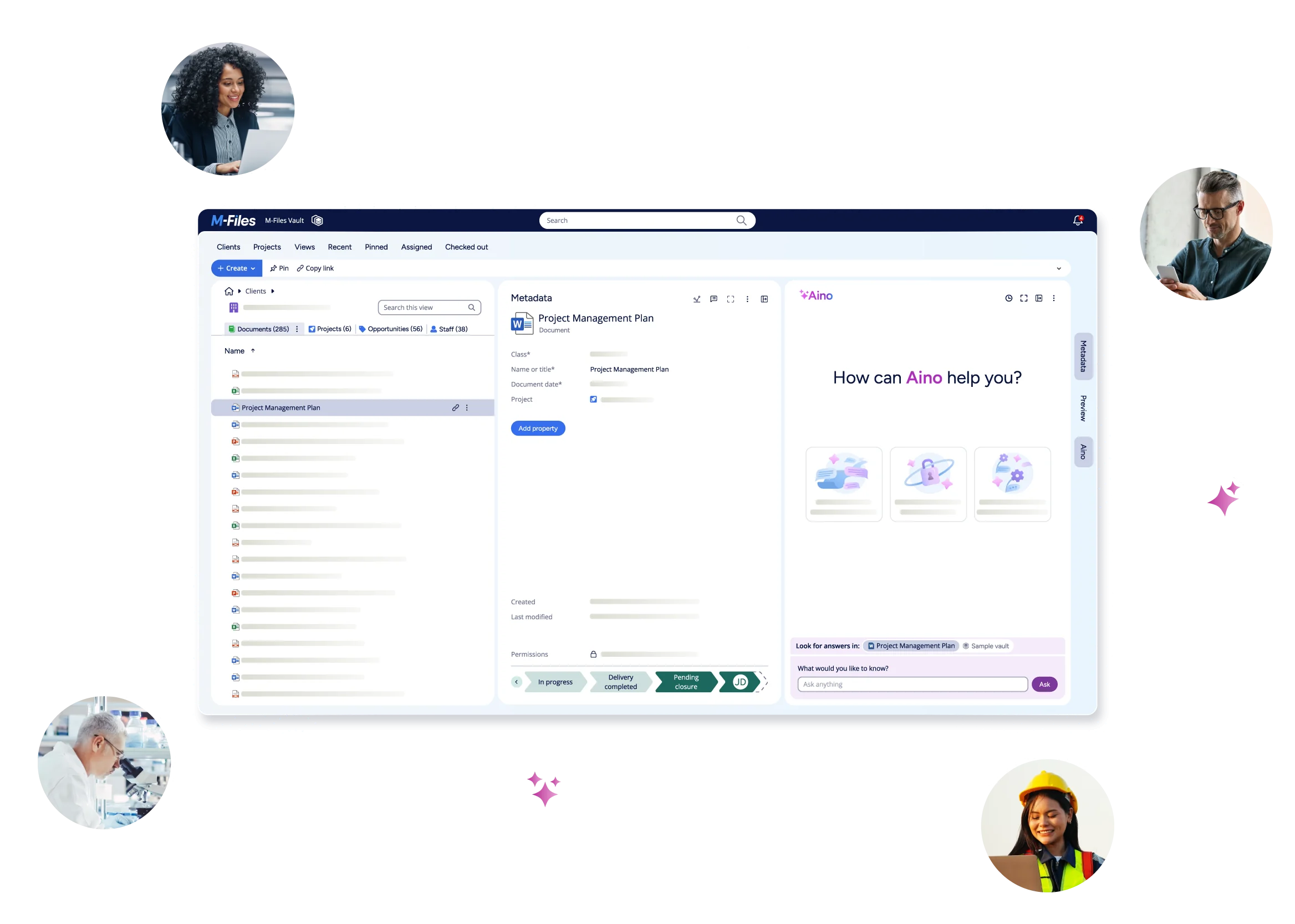
Without business context, AI can only retrieve information. With business context, it can deliver more accurate responses, automate document-centric processes, and support better decisions while respecting governance and security. This is why M-Files is leading the industry. Our context-first architecture, built on a robust enterprise knowledge graph, connects documents with the people, processes, and business objects surrounding them. Just as important, it strengthens information governance, which is recognized as an advanced and essential capability by Nucleus, enabling AI to apply context, permissions, and metadata to enterprise knowledge. Rather than layering AI on top of disconnected repositories, M-Files provides AI with trusted, governed enterprise knowledge that can be understood, reasoned over, and acted upon responsibly.
The market is moving beyond storage
One of the most notable observations from Nucleus Research is that organizations increasingly expect their content platform to become the operational hub for document-centric work.
The report highlights several defining trends:
- AI adoption is becoming pragmatic, focused on measurable business outcomes.
- Cloud platforms continue to accelerate innovation and integration.
- Open connectivity with ERP, CRM, HCM, and other enterprise systems is becoming essential.
- Organizations increasingly want content services platforms to organize information based on business context rather than repository location.
These trends closely align with the principles behind context-first document management. They also establish the foundation for the next generation of enterprise AI, where intelligent agents can orchestrate multi-step processes across multiple business systems while working with trusted enterprise information.
Beyond AI assistants
Nearly every vendor in this year's Leader and Expert quadrants offers AI assistants, each delivering efficiency and automation gains which are important. But the future is moving beyond simplistic AI-task automation.
Organizations seeing a document management system that will help them support every stage of their AI maturity strategy need to ask themselves, "Which platform provides AI with the richest understanding of enterprise information?"
This is M-Files sweet spot and something we've been doing since our inception. We've always believed our architectural, metadata approach has been a competitive advantage. Today, we're seeing the fruits of our labor as the essential foundation for successful enterprise AI where documents become connected business objects that AI can then understand and act on, while automatically respecting permissions, governance, and compliance requirements.
Why Microsoft matters
Organizations don't want another destination for documents. They want intelligent document management embedded inside the tools employees already use.
Nucleus Research highlights that the overarching collaboration aspect of content services platforms is taking center stage, as organizations look for content to move seamlessly across the systems where work happens. For many organizations Microsoft is the collaboration layer where knowledge workers work.
M-Files has leaned heavily into this reality with our strategic partnership with Microsoft. The Nucleus report highlights M-Files' native Microsoft 365 solutions, including SharePoint, Microsoft Teams, Microsoft Outlook, Microsoft Purview, and Microsoft Copilot.
This reflects a broader philosophy: organizations shouldn't have to choose between Microsoft productivity and enterprise document management. They should get both.
Recent M-Files innovations further strengthen this strategy by enabling Microsoft 365 Copilot to access context-enriched, governed enterprise content, helping improve AI accuracy while maintaining security and compliance.
Preparing for the organizational intelligence future
Documents remain where knowledge is created, decisions are recorded, compliance is demonstrated, and work moves forward. The challenge organizations face is no longer where documents are stored. It's whether AI can understand the information inside them in the context of the business.
As the content services market continues to evolve, lasting differentiation will come from connecting AI with trusted enterprise context, not simply adding more AI features. Recognition in this year's Nucleus Research CSC Technology Value Matrix reflects this broader shift. As enterprise AI matures, organizations will increasingly need information that is connected, governed, and meaningful, enabling AI to reason with confidence rather than simply retrieve files.
That's the opportunity for context-first document management, and it's the approach M-Files has been building from the beginning.
Latest Articles
Browse Topics
Resources
See M-Files in Action