
M-Files CEO Q&A: Why Context Matters for AI and Performance
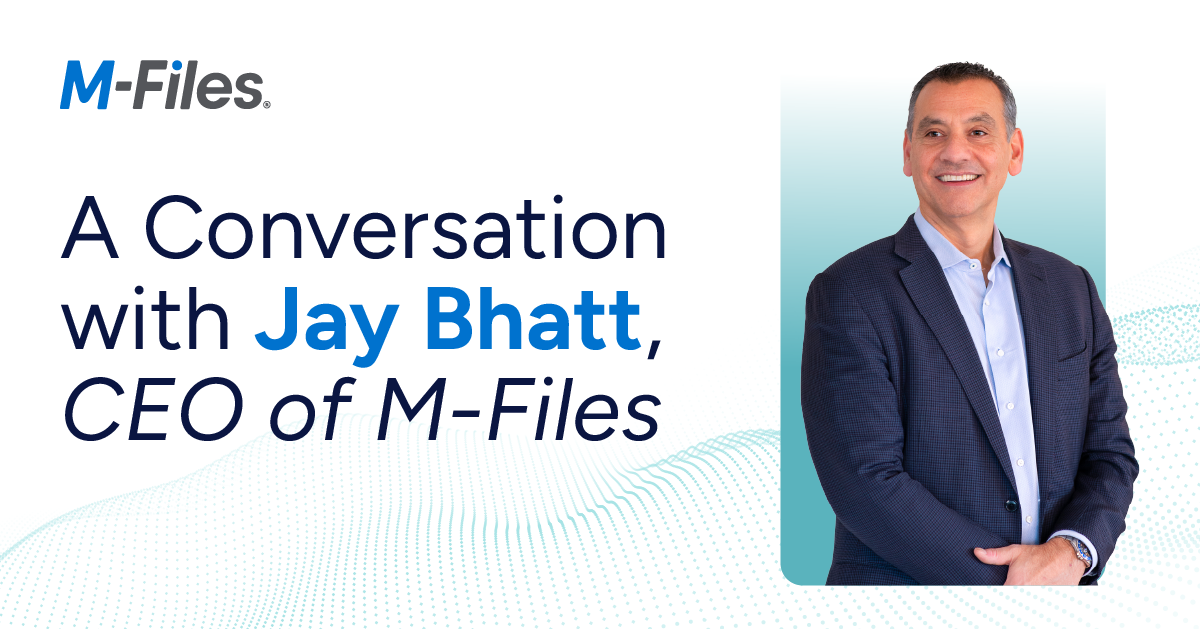

A Conversation with Jay Bhatt, CEO of M-Files
For years, organizations have invested heavily in modernization, automation, and now AI to move faster and operate more efficiently. Yet many leaders feel a growing gap between the technology they’ve deployed and the performance they’re able to achieve.
In this conversation, Jay Bhatt, CEO of M-Files, shares his perspective on what’s really holding organizations back, why documents have become a critical, and often overlooked, part of business infrastructure, and how a context-first approach can help leaders reduce operational friction and unlock real performance gains in the age of AI.
1. From your vantage point as a CEO, what is fundamentally changing about how modern organizations operate?
What’s changed most is the pace and complexity of work. Work now happens across more systems, more teams, and more external partners than ever before and it rarely follows a clean, linear path.
At the same time, expectations have gone up. Leaders are expected to move faster, stay compliant, and make confident decisions in real time. The challenge is that many operating models and systems were designed for a simpler era. That mismatch is becoming impossible to ignore.
2. Many organizations are investing heavily in AI, automation, and modern work platforms yet performance often feels constrained. What’s getting in the way?
Technology on its own doesn’t eliminate complexity. In many cases, it actually exposes it.
Performance suffers when information is fragmented, disconnected, or difficult to trust. People spend too much time searching for documents, reconciling versions, or validating decisions instead of moving work forward. That operational friction compounds across the organization and it limits impact, even when the right tools are technically in place.
3. You’ve said that documents are the DNA of modern business. What do you mean by that?
Documents are where the real substance of the business lives. They capture decisions, obligations, approvals, and institutional knowledge over time.
Contracts, policies, project files, and client records aren’t just byproducts of work – they are the work. They underpin operations, compliance, and accountability. When documents aren’t managed well, everything built on top of them becomes slower and more fragile.
4. What breaks when documents are treated as static files instead of living business assets?
The first thing that breaks is context. People lose visibility into why decisions were made, who owns what, and how work connects across processes.
That leads to delays, rework, and unnecessary risk. Over time, trust erodes both in the information and in the systems meant to manage it. When that happens, teams fall back on workarounds, institutional knowledge, and manual checks. That’s when performance really starts to suffer.
5. AI is everywhere in the conversation today, but real business impact is still elusive. Why?
Because AI is only as good as the information it’s built on.
In most organizations, information is scattered across systems, inconsistently managed, and governed unevenly. Without a strong foundation, AI produces outputs that are hard to trust or explain. Instead of accelerating decisions, it introduces doubt. That’s why so many AI initiatives stall after early experimentation.
6. What must be true for AI to be trusted and useful in real business environments?
AI needs access to information that is accurate, current, and rich in context, and it needs to operate within clear governance and security boundaries.
Trust comes from understanding where information came from, how it relates to the business, and why an outcome makes sense. If leaders can’t explain or defend AI-driven decisions, they won’t use them in real operational or compliance-critical scenarios. That’s why architecture matters. AI needs structured meaning and relationships, not just access to files.
7. How should business and IT leaders rethink document management if they want to improve performance and unlock AI’s potential?
They need to stop thinking about documents as storage and start treating them as part of the operating fabric of the business.
When documents are connected to people, processes, and policies, they become reliable inputs for automation, analytics, and AI. That shift changes document management from a back-office function into a performance lever.
8. M-Files talks about a “context-first” approach. What does that change in practice for leaders and their teams?
Context-First Document Management starts with how information is used, not where it’s stored. Documents are automatically connected to the work they support – clients, projects, obligations, and decisions.
For teams, that means less time searching, reconciling, or second-guessing. For leaders, it provides an enterprise knowledge graph that increases visibility and confidence. You can see how work is progressing, where risk is building, and whether policies are being followed without relying on manual updates or institutional memory. And critically, this must happen in the tools people already use every day – like Microsoft 365 – otherwise adoption becomes the bottleneck. That’s how you reduce operational friction at scale.
9. When leaders evaluate solutions to reduce friction and prepare for AI, what criteria matter most?
Leaders need to look past feature lists and ask a few fundamental questions.
First, does the system capture context automatically, or does it rely on people to manually tag, file, or maintain information? If context lives in people’s heads, it won’t scale and AI won’t either.
Second, is trust built in by design? That means governance, security, and accountability aren’t bolted on later, they’re inherent. Leaders need to know where information came from, how it’s connected, and whether it can be relied on for real decisions.
Third, can AI reason on meaning, not just retrieve content? The difference between searching documents and understanding relationships is the difference between inquiry and impact.
And finally, does it fit naturally into how people already work? The fastest way to stall progress is to introduce systems that require behavioral change just to get value. The systems that scale meet teams where they are and automatically remove friction in the background.
When those criteria are met, performance improves almost as a byproduct. When they aren’t, organizations end up with more tools but not better outcomes.
10. As you look ahead, what mindset shift will matter most for leaders who want to stay competitive?
The leaders who succeed will be the ones who focus on reducing operational friction by capturing context across their organizations.
Speed, compliance, and AI readiness all build on that foundation. When systems reflect how work actually happens, and when information can be trusted, everything else becomes easier to scale.
Latest Articles

Browse Topics
Resources

Try M-Files Free for 30 Days!
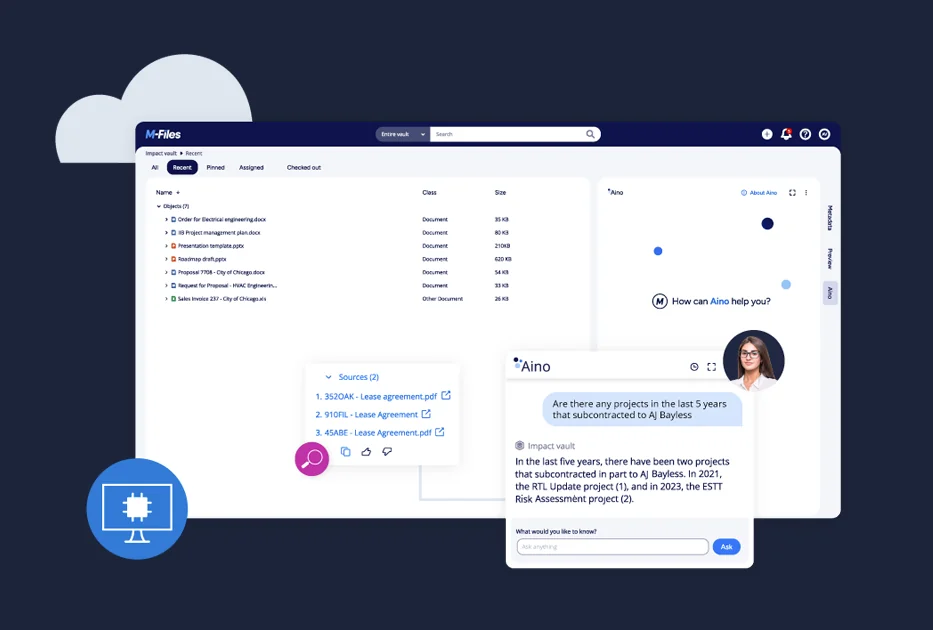
Explore the GenAI capabilities of M-Files Aino, enhance collaboration with colleagues, automate workflows, and unlock endless possibilities.