
Why AI Document Workflows Struggle to Scale without Context
Why AI Document Workflows Struggle to Scale without Context
Building a Simple AI-Driven Document Workflow
Most organizations can build a basic AI document workflow. The system captures a document, extracts the data, triggers a workflow, and tasks move forward from there.
At a small scale, this works well. Early results are often where manual effort drops, processing speeds improve, and teams start to see what automation can do. But once workflows expand beyond isolated use cases, the limitations show up fast.
Exceptions pile up, and routing gets inconsistent. AI outputs need validation before anyone trusts them, and teams end up relying on manual intervention just to keep things moving. What looked like a scalable solution starts introducing new operational friction instead of removing it. The issue isn’t the concept of an AI-driven workflow. It’s what the workflow is missing.
This is where a document management platform like M-Files, which focuses on the document's context, changes the equation. Instead of treating a document as an isolated file to be routed through steps, M-Files automatically classifies and enriches every document with metadata and relationships, connecting it to the vendors, clients, projects, and contracts it belongs to from the moment it's captured. That metadata-driven context is what keeps a workflow reliable as it scales, and it's the gap this post digs into.
Workflows without context become fragile
Most AI document processing workflows are built around steps. A document moves from one stage to the next based on predefined rules, typically triggered by extracted data, document classification, or manual user input. This model assumes that the system has enough information to make accurate decisions at each step. In reality, it doesn’t.
A document is more than a file moving through a process. It represents something within the business, and it may be tied to a vendor, a client, a project, a contract, an invoice, containing PII data, or a regulatory requirement. Its meaning comes from these relationships, and when those relationships are not captured explicitly, workflows rely on assumptions and processes break down.
As complexity increases, workflows become fragile. Routing decisions require human interpretation, exceptions require manual resolution, and AI outputs cannot be trusted without verification because the system lacks the context needed to understand the document’s role. The workflow continues to function, but not reliably.
Why AI alone cannot solve workflow complexity
AI has significantly improved how organizations process documents. It can extract structured data, classify documents, and trigger actions with increasing accuracy, and these capabilities are valuable, particularly for reducing manual effort at the point of document intake. However, AI alone doesn’t solve the broader problem of workflow complexity.
Extraction answers the question: What does this document say? Workflows require answers to different questions:
- What is this document in the context of the business?
- What process does it belong to?
- What rules apply to it?
- What should happen next?
These aren’t content-level questions. They’re context-level questions. Without a consistent way to capture and apply context, workflows remain dependent on people to interpret documents and guide decisions, which limits scalability and introduces variability. AI can accelerate individual steps of document workflow automation, but it can’t ensure that the overall process operates with clarity and consistency.
The shift from step-based workflows to context-driven workflows
To build workflows that scale, organizations need to rethink how workflows are structured. Traditional workflows are step-based: they define a sequence of actions and rely on rules to move documents from one stage to the next. Context-driven workflows take a different approach, focusing on relationships instead of steps.
In context-driven workflows, documents are connected to the entities they relate to: clients, vendors, projects, contracts, and processes. M-Files captures these relationships as structured metadata and maintains them throughout the document lifecycle. This allows your document management system to understand what a document is and how it fits into your business.
Once that understanding exists, workflows become more dynamic. Routing decisions are based on ownership and relationships rather than static rules, exceptions are identified through inconsistencies in context rather than predefined conditions, and the system assigns approvals automatically based on responsibility. The workflow adapts because the system understands the work. That’s the foundation of intelligent document workflows: automation that adjusts because it understands context, not because it follows a fixed rule.
A practical example: Invoice processing
The difference between these approaches becomes clear when applied to a common process such as invoice handling. In a traditional AI-driven workflow, an invoice is processed based on extracted data, and approval paths are determined by rules tied to fields such as amount or vendor. When the invoice doesn’t fit those rules, the process requires manual intervention.
In a context-driven workflow, M-Files immediately connects the invoice to the vendor, contract, project, and cost center it belongs to, and these relationships provide the context needed to guide the workflow. M-Files routes approvals automatically based on ownership, uses Custom Agents to check the invoice against contract terms and flag exceptions for review, and applies governance consistently because the system understands what the document represents. The workflow doesn’t just move faster. It becomes more reliable and less dependent on manual oversight.
Why context enables scalable workflows
As workflows expand across an organization, consistency becomes increasingly important, and context provides that consistency. When context is captured automatically and applied uniformly, workflows can operate across departments, systems, and use cases without requiring constant redesign.
Context-first document management gives your business several important benefits:
- Reduces operational friction: teams spend less time interpreting documents and resolving exceptions.
- Improves decision quality: documents are evaluated within the full context of the business, reducing the likelihood of errors.
- Enables more effective AI-powered document workflow automation: AI systems can rely on structured relationships rather than trying to infer meaning from content alone.
Together, these benefits allow M-Files to help your workflows scale without increasing complexity.
From automation to understanding
The evolution of document workflows isn’t simply about increasing automation. It’s about improving understanding. Automation focuses on executing predefined tasks more efficiently, while understanding enables systems to make better decisions, and context is what bridges this gap.
By embedding context into the foundation of document management, organizations create workflows that are not only faster, but also more accurate, adaptable, and trustworthy. This is what allows AI to move beyond isolated use cases and become a core part of how work is executed.
Making context-driven workflows real with M-Files
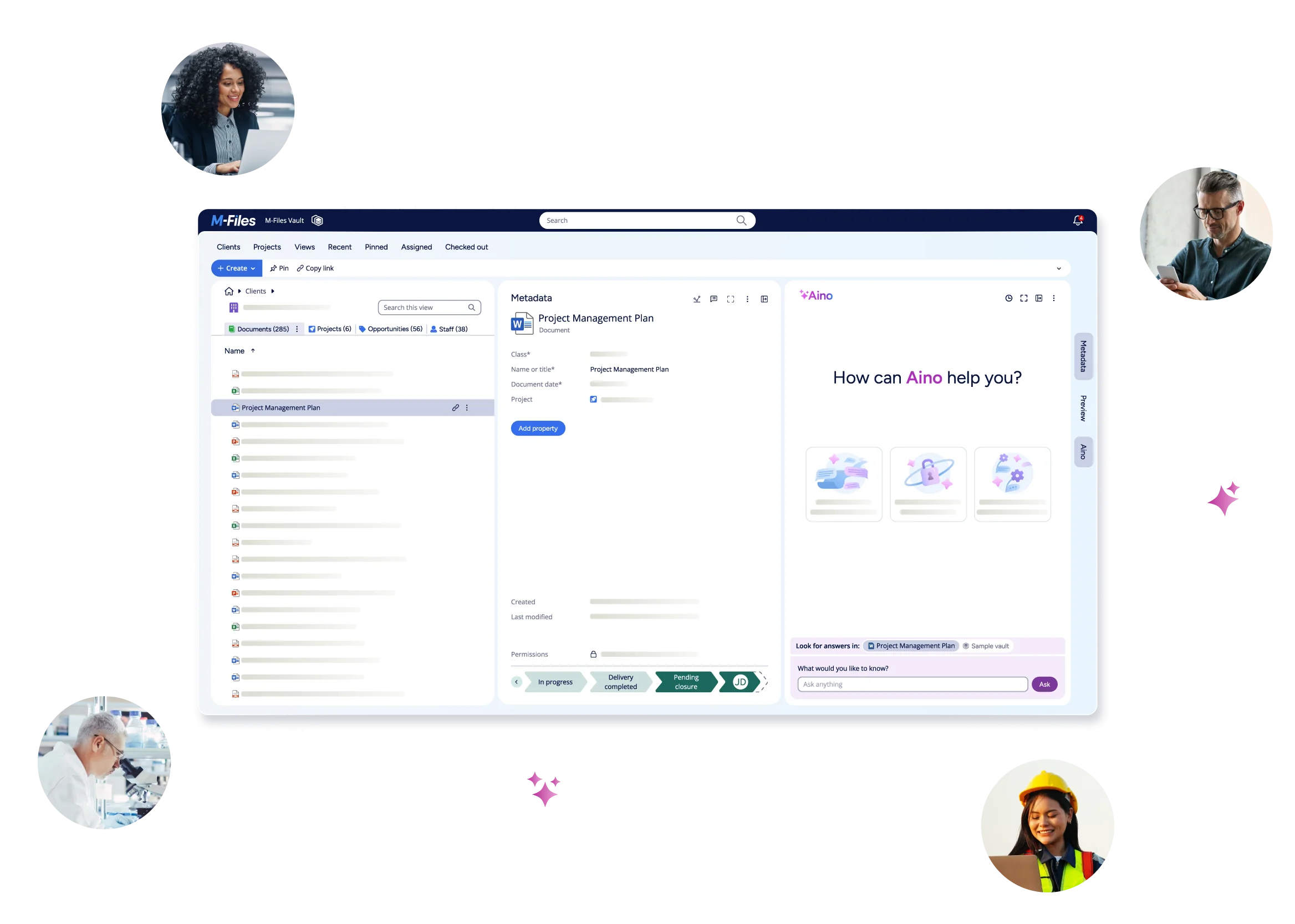
Context-first document management provides the foundation for building these workflows. M-Files is a context-first document management system built to make this possible. Instead of organizing documents by location, M-Files organizes them based on what they are and how they relate to the business, using an Enterprise Knowledge Graph that connects documents to the people, projects, and systems they belong to, and this context is captured continuously and applied consistently.
Workflows in M-Files are driven by this context. M-Files routes documents, assigns approvals and applies governance based on relationships rather than static rules, and Custom Agents extend this further by automating judgment-based steps, like checking an invoice against contract terms before routing it for approval. M-Files AI operates on this same structured, trusted information, so outcomes are more reliable and easier to explain. Because M-Files is native to Microsoft 365, these context-driven workflows plug directly into Teams, SharePoint, and Copilot, so teams can adopt them without leaving the tools they already use.
Context is the difference
AI document workflows don’t fail because they lack automation. They fail because they lack context. When context is embedded into document management, workflows become more adaptable, more reliable, and easier to scale, and AI becomes more effective. M-Files makes this possible, capturing that context automatically through metadata, relationships, and structured workflows, so AI operates within a structured environment that reflects how the business actually works. This enables organizations to move from isolated automation to sustained performance improvement with M-Files.
Ready to discover the power of M-Files? Schedule a demo now.
Latest Articles
Browse Topics
Resources
See M-Files in Action