

BonsenReuling
How BonsenReuling Built a Context-First Information Foundation for Findability, Governance and AI with M-Files
Highlights
- Improved findability and reduced information sprawl: M-Files replaced fragmented folder structures with metadata-driven information management.
- Successful transition to cloud-based work: BonsenReuling modernized its IT environment and moved away from on-premises infrastructure.
- Strong user adoption across the organization: Business-led implementation and hands-on training accelerated adoption.
- Foundation for AI and Microsoft 365 innovation: Structured metadata and governance support future AI and Microsoft 365 Copilot initiatives.

Use Case
Quality Management
Risk and Compliance Management
Industry
Accounting & Advisory Services
Country
Netherlands
Share This Story
Company Introduction
BonsenReuling is an accounting and advisory firm with more than 230 employees and eight offices across the eastern Netherlands. Founded in 1923, the company supports organizations ranging from sole proprietorships to audit-required enterprises.
As a trusted advisor to its customers, BonsenReuling places strong emphasis on precision, structure and efficiency, both externally and internally. Managing documents and customer records effectively is a critical part of supporting employees and delivering high-quality client service.
As the organization continued to modernize its IT environment, improving document management and information accessibility became a key priority.
Key Challenges Before M-Files
Difficulties Finding the Right Information
Before implementing M-Files, BonsenReuling relied on an on-premises document management system built around traditional folder structures. Although metadata existed, inconsistent tagging and incorrect document classifications made information difficult to locate. Employees frequently contacted IT for help finding missing documents or customer records.
“Employees regularly submitted support tickets saying, ‘I can’t find a document, can you help me search for it?’” recalls Maarten van der Veer, ICT Manager at BonsenReuling.
This created frustration for employees and reduced productivity across the organization.

Legacy Infrastructure Limiting Modern Work
At the time, BonsenReuling still operated in an RDS-based environment where employees worked through centralized servers instead of modern local workstations.
Coming from a fully integrated Microsoft Cloud environment, Maarten immediately identified the need to modernize both infrastructure and document management. The organization wanted to move toward a fully SaaS-based environment that could scale with the business and support more flexible ways of working.
Metadata Inconsistencies and Limited Governance
The existing system relied heavily on folder structures, while metadata quality varied significantly. Documents were sometimes linked to the wrong customer or tagged inconsistently, making them difficult or impossible to retrieve. Retention policies were also difficult to enforce consistently across the organization.
"If you have a lot of documents and need to find them quickly and easily, there is nothing better than M-Files."
Maarten van der Veer, ICT Manager, BonsenReuling
The M-Files Solution
Moving From File Storage to Intelligent Information Management
BonsenReuling evaluated seven document management solutions before selecting M-Files through implementation partner GeONE.
The decision was ultimately driven by the philosophy behind M-Files: focusing on what a document is rather than where it is stored.
“The deciding factor was the philosophy behind M-Files: not where the document is stored, but what the document is,” Maarten explains.
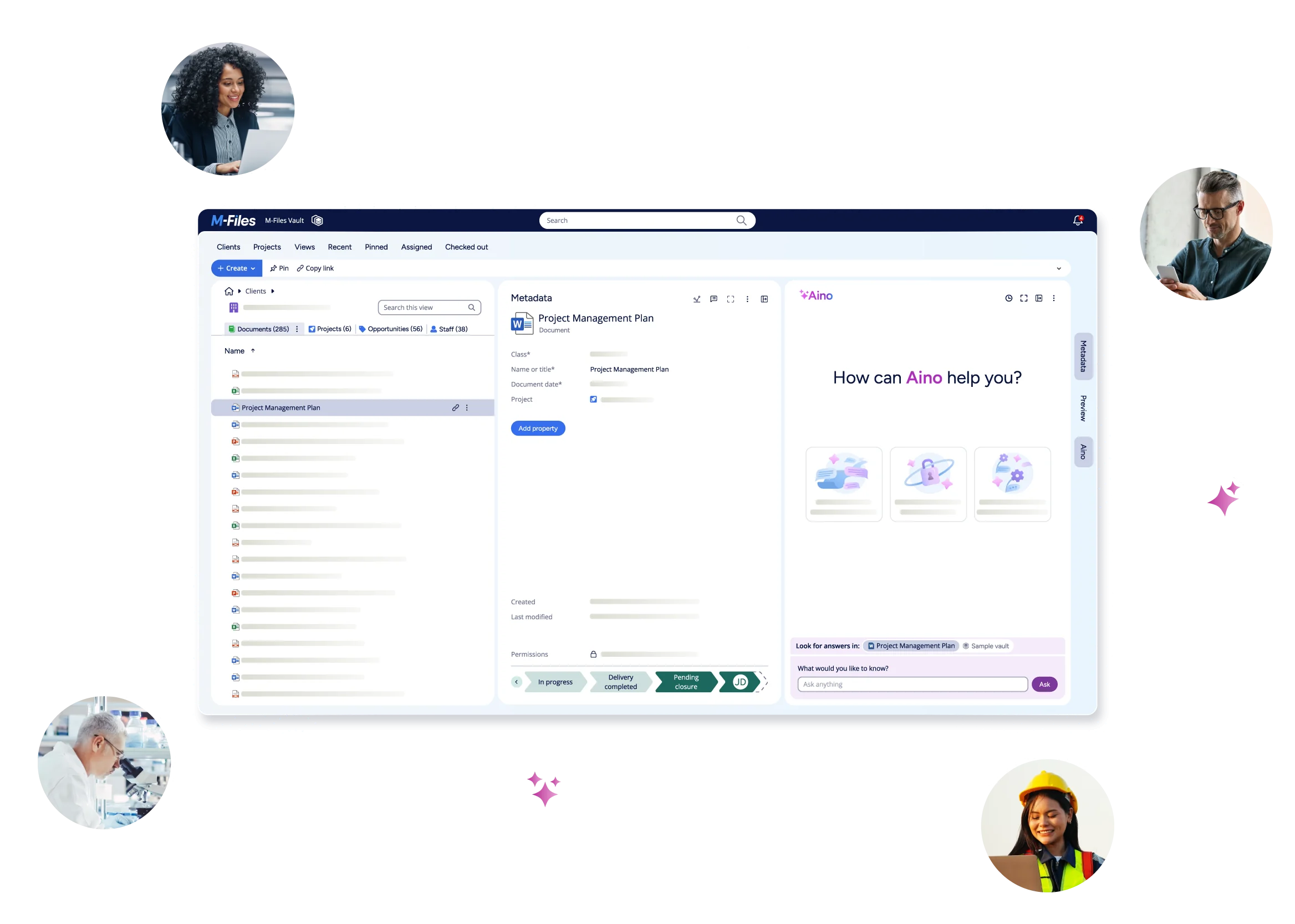
M-Files introduced a context-first approach to managing information, where documents are organized and accessed based on metadata such as customer, process or document type instead of folder location.
This significantly improved how information is structured, searched and managed across the business.
A Business-Led Implementation Approach
BonsenReuling intentionally approached the implementation as a business project rather than an IT project. Key users from across the organization participated in proof-of-concept sessions, testing workflows and helping shape the final solution. The organization also involved critical users early in the process to encourage adoption and gather practical feedback.
“We deliberately included the people who openly questioned why this change was needed. Once you convince those people, the rest follows naturally,” Maarten says.
GeONE supported the process by sharing best practices and helping guide discussions, while ensuring that final decisions remained with the business teams using the system.
Simplifying Adoption Through Familiar Structures
Transitioning from folders to metadata required employees to adopt a new way of thinking about information management. To simplify the transition, BonsenReuling recreated familiar folder structures within M-Files while gradually introducing metadata-driven workflows.
All employees participated in mandatory training sessions using a test environment populated with real customer documents and data. Additional Microsoft Teams-based support sessions gave employees opportunities to ask questions and reinforce adoption after go-live.
“The people who had the strongest opinions at the beginning are now the people who enjoy working with M-Files the most,” Maarten notes.
Supporting Scalability and Business Growth
Shortly after go-live, BonsenReuling merged with another accounting firm operating on a different DMS and file-sharing environment. Using migration tooling provided by GeONE, the organization successfully migrated all users and data into the existing M-Files environment with minimal disruption. The same tooling is now also used for bulk archiving and large-scale document classification processes.
The Results
Faster and More Reliable Access to Information
Employees can now find documents quickly and reliably using metadata-driven search instead of navigating folder structures.
“If you have a lot of documents and need to find them quickly and easily, there is nothing better than M-Files,” Maarten says.
The reduction in search-related issues has significantly improved day-to-day productivity and reduced dependency on IT support.
Improved Adoption Across the Organization
The combination of hands-on training, business involvement and a pragmatic rollout approach contributed to strong adoption across the company.
Employees who were initially skeptical about the transition are now among the most active M-Files users.
“People are genuinely positive about how easy it is to store and retrieve documents. That’s the biggest win we achieved,” Maarten highlights.

"People are genuinely positive about how easy it is to store and retrieve documents. That’s the biggest win we achieved."
Maarten van der Veer, ICT Manager, BonsenReuling
Successful Cloud Modernization
M-Files supported BonsenReuling’s broader transition toward a cloud-first IT environment. The company has moved away from local infrastructure and on-premises servers, creating a more scalable and flexible operating model.
A Foundation for Microsoft 365 Copilot and AI Innovation
BonsenReuling closely follows the strategic partnership between M-Files and Microsoft and sees strong potential in combining M-Files with Microsoft 365 Copilot and other AI capabilities. The organization believes that structured metadata, governance and access controls are essential prerequisites for successful AI adoption.
“The foundation has to be right. Once that’s in place, you can move very quickly and really unlock the power of AI tools,” Maarten explains.
Looking Ahead: Expanding AI and Microsoft 365 Opportunities
BonsenReuling continues to explore new opportunities around AI, Microsoft 365 integration and metadata-driven information management. With a structured, context-first information foundation now in place, the organization is well positioned to further improve efficiency, collaboration and client service through automation and AI innovation.
Partner
GeONE
GeONE consists of a group of enthusiasts who delight in information and document management challenges from organisations that want to move forward. Organisations that realise that data, documents and information play a defining role in their success. Tomorrow even more than today.
Where others are guided by software and its functionalities, for GeONE customers' business processes are the starting point. With intelligent solutions, GeONE optimizes those processes and align them with business objectives.

Contact

See M-Files in Action
Seeing is believing. Request a live demo to discover how AI-powered document management in context can transform your organization.