

Berggren
Learn How Berggren Accelerates AI-Powered Intellectual Property Management with M-Files Cloud
Highlights
- Managing intellectual property information at scale: M-Files supports 150 users and more than 7 million documents across Berggren's core business processes.
- AI-powered intellectual property workflows: M-Files AI summarizes patent documents, identifies deadlines, extracts required actions, translates content and enriches metadata automatically.
- Metadata-driven information management: Structured information and automated workflows connect information, processes and expertise across the entire intellectual property lifecycle.
- Building a cloud foundation for future innovation: Berggren is migrating to M-Files Cloud to strengthen reliability, security, scalability and AI readiness even further.


Use Case
Customer Information Management
Quality Management
Risk and Compliance Management
Industry
Intellectual Property Services
Country
Finland
Share This Story
Company Introduction
Founded in 1936, Berggren is an international full-service intellectual property law firm providing services across the entire IP lifecycle. The company helps organizations protect, manage, commercialize and defend patents, trademarks, designs and other intellectual property assets.
Today, Berggren employs approximately 150 professionals and serves more than 4,000 clients globally through offices in Finland, Germany, Spain and China. The company manages thousands of intellectual property assignments annually, supporting clients ranging from start-ups and research organizations to global brands and publicly listed companies.
Intellectual property work depends on information. Patent filings, legal correspondence, technical documentation, client communications and regulatory requirements all need to be accessible, traceable and connected to the right business context. As information volumes continued to grow, Berggren needed a way to manage increasing complexity while supporting automation, expert work and future AI initiatives.
Key Challenges Before M-Files
From Paper Archives to Digital Information Management
Berggren's digital transformation journey began in 2008 with a significant challenge: replacing approximately 400 shelf meters of paper archives with a modern digital information management environment.
While many documents had already been digitized, a large portion of the company's information remained scattered across archives, network drives, folders and subfolders. Finding the right document, or even the latest version of a document, often required manual effort and local knowledge.
As intellectual property information continued to grow in volume and strategic importance, Berggren needed a more scalable and structured approach.
Managing Millions of Documents Efficiently
Intellectual property management is inherently document-intensive. Patent applications, trademark filings, legal correspondence, technical documentation and client records all generate large volumes of information that must remain accessible and traceable over long periods of time. The company needed a solution that could support increasingly complex processes while helping experts find relevant information quickly and reliably.

"We shared the same vision with M-Files from the beginning. Metadata-driven information management was the future and the best way to manage the scale and complexity of our document environment."
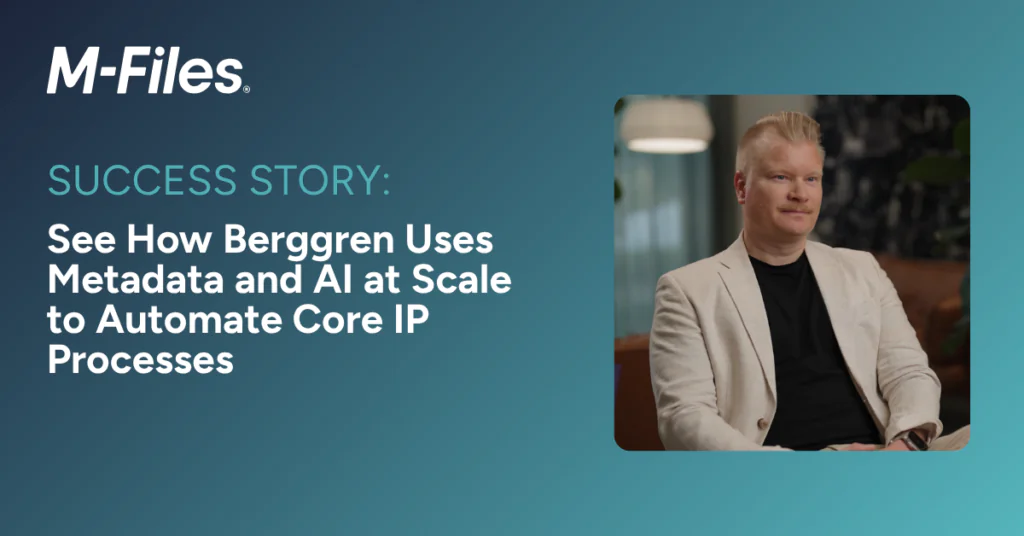
Mikko Pippuri, Digital Ninja, Berggren
When evaluating document management solutions, Berggren recognized that traditional folder-based approaches would not scale effectively to its growing information environment. Instead, the company saw greater long-term value in managing information through metadata.
"We shared the same vision with M-Files from the beginning. Metadata-driven information management was the future and the best way to manage the scale and complexity of our document environment," said Mikko Pippuri, Digital Ninja at Berggren.
Preparing Information for Future Automation and AI
In the past years, As Berggren expanded its use of automation and AI, the importance of structured information became even more apparent.
The company understood that AI could only deliver meaningful results if information was properly organized, classified and connected to the right business context. Metadata would become increasingly important not only for finding information but also for enabling accurate AI-driven outcomes.

"Good metadata has become even more important in the AI era. It helps us provide the right context, improve the quality of responses and avoid processing unnecessary information."
Mikko Pippuri, Digital Ninja, Berggren
The M-Files Solution
Building a Metadata-Driven Information Foundation
Berggren selected M-Files in 2008 and has relied on it as its central content management platform ever since.
Over nearly two decades, the company has transformed M-Files into a business-critical platform supporting document management, workflow automation, information governance and expert knowledge work.
Rather than organizing information through folder structures, Berggren manages information through metadata. Documents are connected to clients, cases, deadlines, intellectual property rights, countries and business processes, making information easier to find and use. Today, Berggren has created a highly structured information environment that allows information to be surfaced, processed and analyzed in the appropriate business context.
Connecting Information and Core Business Processes
Today, all of Berggren's core intellectual property processes are managed through M-Files. The platform not only guides employees through the correct process steps but also automates routine activities, reduces manual effort and helps minimize errors.
Metadata and workflows work together to ensure that information moves efficiently through the organization while remaining governed and traceable. This combination of structured information and process automation has enabled Berggren to scale its operations while maintaining consistency across thousands of client engagements.
Building Reliable AI on a Foundation of Metadata
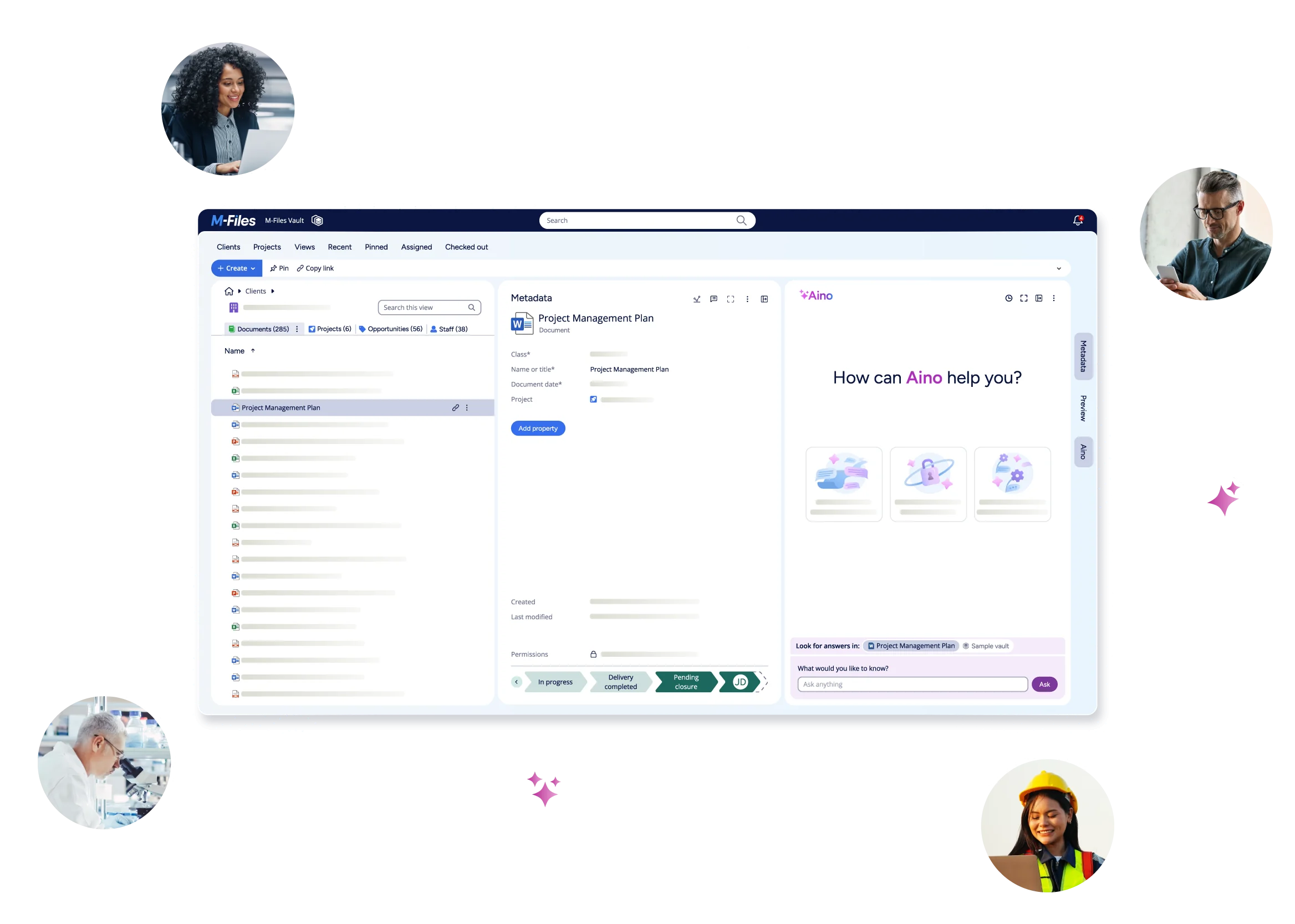
Berggren uses M-Files AI to support a growing range of intellectual property workflows. The company receives documents from clients, authorities and partners around the world in dozens of languages. M-Files AI helps professionals summarize documents, translate content, identify deadlines, extract required actions and automatically populate metadata.
For example, M-Files AI can identify filing deadlines within lengthy patent correspondence, determine whether a document requires action and generate structured summaries that can be incorporated into workflows. Metadata enrichment has become one of the most valuable use cases. In many situations, M-Files AI can identify a case number and use it to populate numerous additional metadata values automatically, reducing manual work while improving consistency.
"Good metadata has become even more important in the AI era. It helps us provide the right context, improve the quality of responses and avoid processing unnecessary information," Mikko notes. Berggren views metadata as the foundation that makes AI practical at scale. By ensuring that only relevant information is provided for each task, the company improves AI accuracy, reduces processing costs and provides professionals with more reliable results.
Extending AI Beyond Document Processing
Beyond document intelligence, Berggren has developed several AI-supported solutions that leverage information managed within M-Files. The company uses AI to support conflict checking, helping identify potential conflicts of interest across intellectual property matters. AI is also used for intellectual property analysis and automated invoice processing.
One particularly innovative use case involves counterfeit detection. By integrating with major online marketplaces, AI can identify potentially counterfeit products, detect suspicious sales activity and help connect related sellers into larger networks. This allows Berggren and its clients to identify risks more efficiently and support enforcement efforts with relevant evidence.
Building a Cloud Foundation for Future Innovation
To support future growth and innovation, Berggren is currently migrating its M-Files environment to M-Files Cloud as part of a broader Azure-based cloud transformation initiative. The move to M-Files Cloud improves reliability, strengthens security and increases scalability while reducing infrastructure management demands. It also enables modern collaboration capabilities, including co-authoring, while supporting the company's ongoing ISO 27001 information security initiatives.
The Results
Managing Intellectual Property Information at Scale
Today, Berggren manages more than 7 million documents within a centralized information management environment that supports 150 users across the business. What began as a project to digitize paper archives has evolved into a business-critical platform supporting document management, workflow automation, AI initiatives and intellectual property processes across the organization.
Faster Access to Information and Greater Automation
By replacing information silos with a metadata-driven approach, Berggren has significantly improved information discoverability and accessibility.
Professionals can locate relevant information quickly without relying on folder structures or manual searches. Automated workflows reduce repetitive administrative work while helping ensure that information moves efficiently through business processes.
This allows intellectual property experts to focus more time on high-value advisory and legal work and less time managing information manually.

"M-Files supports our business at the core of what we do. Strong metadata, automation, AI and cloud capabilities help us deliver better service while managing an increasingly complex information environment."
Mikko Pippuri, Digital Ninja, Berggren
Better AI Outcomes Through Better Context
Berggren's long-term investment in metadata has become increasingly valuable as AI capabilities have matured. Because information is structured, connected and governed, AI can operate with the business context needed to deliver more accurate and relevant results. Rather than processing large volumes of unrelated information, AI can focus on the information most relevant to a specific task.
This improves response quality, supports governance requirements and helps control the cost of AI processing.
Creating the Foundation for the Next Generation of IP Services
The move to M-Files Cloud represents the next stage in Berggren's information management journey. By combining metadata-driven information management, workflow automation, AI-powered capabilities and cloud scalability, Berggren has built a platform that connects information, expertise and processes across the entire intellectual property lifecycle.
"M-Files supports our business at the core of what we do. Strong metadata, automation, AI and cloud capabilities help us deliver better service while managing an increasingly complex information environment," Mikko concludes.
After nearly two decades of continuous development, M-Files remains central to how Berggren manages information, supports experts and prepares for the future of intellectual property services.
See M-Files in Action
Seeing is believing. Request a live demo to discover how AI-powered document management in context can transform your organization.