
Charles River Laboratories
Charles River Laboratories Streamlines Process Automation, Saving Millions
Highlights
- $2.4 million estimated annual cost savings from improved process efficiency
- 9,600 hours saved per year from automated document workflows
- $326,400 annual savings in DocuSign costs

Use Case
Risk and Compliance Management
Project Information Management
Customer Information Management
Industry
CRO/Life sciences: Drug Research and Development
Country
United States
Share This Story
Company Introduction
With more than 20,000 workers worldwide, drug-research company Charles River Laboratories (CRL) is the largest provider of discovery, data, nonclinical development, and drug safety testing services worldwide. The Massachusetts-based company was instrumental in the process of drug development for 85% of FDA-approved studies in 2021.
CRL processes tens of thousands of documents for clients every year with tight timelines and high degrees of quality expected. These documents form a key component of drug companies’ submission pipeline for drug approvals. “We are always striving to provide our clients with data more efficiently and as we look to optimize, having access to the metadata around the documents is increasingly important,” said Jenith Charpentier, CRL’s Senior Director, Data and Report Delivery Services.
A key aspect of CRL’s focus is overseeing regulated, study-related safety assessment documentation. Complex areas of expertise, such as drug protocols, tables, and testing reports can grow very document-intensive in a short time. CRL’s safety assessment business unit operates across 20 data sites — up from five in 2010. The unit team collaborates and navigates across those sites to document protocols and processes and to perform scientific investigations.
“Each protocol is a collaborative process with our clients, regulatory bodies, and in-house scientists to ensure that we are preparing the best study possible for that investigation,” Jenith said. “There are layers of internal reviews to manage as well as back and forth with the client, and we need to keep the comments aligned with the versions to ensure we capture everything in the final agreement.”
As her team processes studies, they collect data into multiple regulated platforms that generate detailed documentation, as well as formatted outputs for analysis and data presentation. “To create the main report, we can be combining hundreds of files that have gone through independent review and complicated structures,” Jenith added. “That document is also checked, reviewed, and quality assured before being shared with the client.”
Clearly, such a complex, massive processing of reports, data sets, and regulatory protocols would require a game-changing knowledge work automation platform such that CRL’s knowledge workers could find information faster, eliminate information chaos, and maintain optimal process efficiency and accuracy. However, CRL’s platform couldn’t meet the company’s stringent expectations.
Key Challenges Before M-Files
With a classic folder structure, CRL’s document management platform lacked the capacity to auto-upload documents from standard systems—knowledge workers had to spend hours manually placing files in the right locations.
In addition, the document management infrastructure often housed files in a document “black hole,” making searches difficult and frustrating. Over time, variations in file-naming and location for any given document began to hinder productivity.
“So, I’m clicking—I work at this site and I’m working on this study and this kind of file under this sort of category,” Jenith said. “You might have to drill down seven levels before you get to your file.”
“And then, —oops—what if your colleague differently interpreted where to put that file?” she added. “You have to backtrack up four levels and go down the other pipeline of the tree to see if you can find it over there. So that was what we were doing, and that was sort of one of the headaches associated with it.”
To stay competitive, CRL needed a solution to deliver projects more rapidly to clients while also enforcing clear reporting standards and a commonality of systems across all 20+ sites. CRL also needed that solution deployed with minimal disruption to accommodate their current data load and evolve with rapid growth.


"Charles River was at a technology crossroads and needed an upgraded document management solution to support their growth trajectory. M-Files outperformed the competition in CRL’s calculations on time savings for priority tasks and overall cost savings."
Jenith Charpentier, Senior Director, Data and Report Delivery Services, Charles River Laboratories
The M-Files Solution
After researching 19 document management providers, CRL narrowed the search down to five. Part of that process included perusing Gartner reviews. M-Files has been recognized by customers as a Customers’ Choice in the March 2022 Gartner Peer Insights “Voice of the Customer: Content Services Platforms”. In the report, M-Files was one of five vendors to receive the above market average rating and Customers’ Choice distinction. In fact, 95 percent of respondents would recommend M-Files.
However, Jenith notes that M-Files’ flexibility really sealed the deal: “As a contract research organization, we sometimes find that out-of-the-box solutions don’t suit our needs,” she said. “We were really excited about being able to build vaults and workflows based on our processes and also about the potential for cross-system connection.”
As the industry-leading metadata driven knowledge work automation platform, M-Files helped CRL understand how to best automate document workflows for CRL’s studied designs, which, in turn, drove efficiency across other processes.
“The efforts that we undertook with the M-Files team on the reporting and publishing prep configurations really started to open up those possibilities for us,” Jenith said.
“For example, we designed a separate publishing system that is driven by a collection of information, documents, and metadata from M-Files. This was a trulybcreative and collaborative solution that elevated what we are able to accomplish.”
The Results
Today, CRL uses M-Files to create special views to monitor workflow states and assess adoption and progress. Users can easily view and understand individual and team workloads in a way that would have been impossible under a traditional file-folder structure.
In addition, CRL uses M-Files to facilitate automated handoffs within workflows, obtain necessary e-signatures to satisfy regulatory requirements efficiently, and gain insightful visibility into any given document status. With M-Files, CRL also reduces business risk by maintaining accessible document histories to establish necessary audit chains and satisfy regulations.
Jenith added that her team can use document metadata within a drug study to help choose appropriate templates.
“So, that’s all happening organically within the document management system,” Jenith said.
“And, we’re not having to pick and choose and re-create that in a publishing system. It’s all sitting right there. So that’s a big win in terms of time. That was also a big win in terms of licensing,” she added. Before M-Files, CRL used three different publishing systems following a series of mergers and acquisitions. Now, Jenith’s team uses one. “So, if we’re low on work at one site and high on work at another site, it’s very easy for us to pick things up.”
Today, Charles River Laboratories leverages knowledge work automation to optimize study processes, saving time, costs, and manual labor, while also optimizing ROI. “[With M-Files], we can understand elements of the study design—we get our client, our templates, our sites, and we’re really able to drive actions through that metadata, which is part of what we’re trying to implement across our data pipeline and across our data enablement efforts,” Jenith said.
A savings comparison between CRL’s former document management system and M-Files revealed:
- Streamlined eSignatures, validation, reporting, and publishing
- Upgraded knowledge work automation platform integrated with external
repositories without costly migration. - 15 seconds saved per document processed—8,658 hours per year
- Total estimated costs savings: $2.4 million

"Before M-Files, CRL used three different publishing systems following a series of mergers and acquisitions. With M-Files, we designed a separate publishing system that is driven by a collection of information, documents, and metadata from M-Files. This was a truly creative and collaborative solution that elevated what we are able to accomplish."
Jenith Charpentier Senior Director, Data and Report Delivery Services, Charles River Laboratories
“I’ve been doing this for a long time, and it gets easy to tell when a vendor is actively listening to your needs and serving back ways that the system can help to meet them – rather than rephrasing the marketing materials,” Jenith said. “It was exciting to be interacting with a company who was engaging with our ideas from the beginning, and I’ve been thrilled with a continued relationship along those lines.”
For Jenith, the success of the partnership is a natural reflection of CRL’s team success: “We have about 20,000 employees globally. Their collaboration and efficiency helped drive $3.5 billion in revenue in 2021, which was more than 20-percent year-over-year growth for the company,” she said.
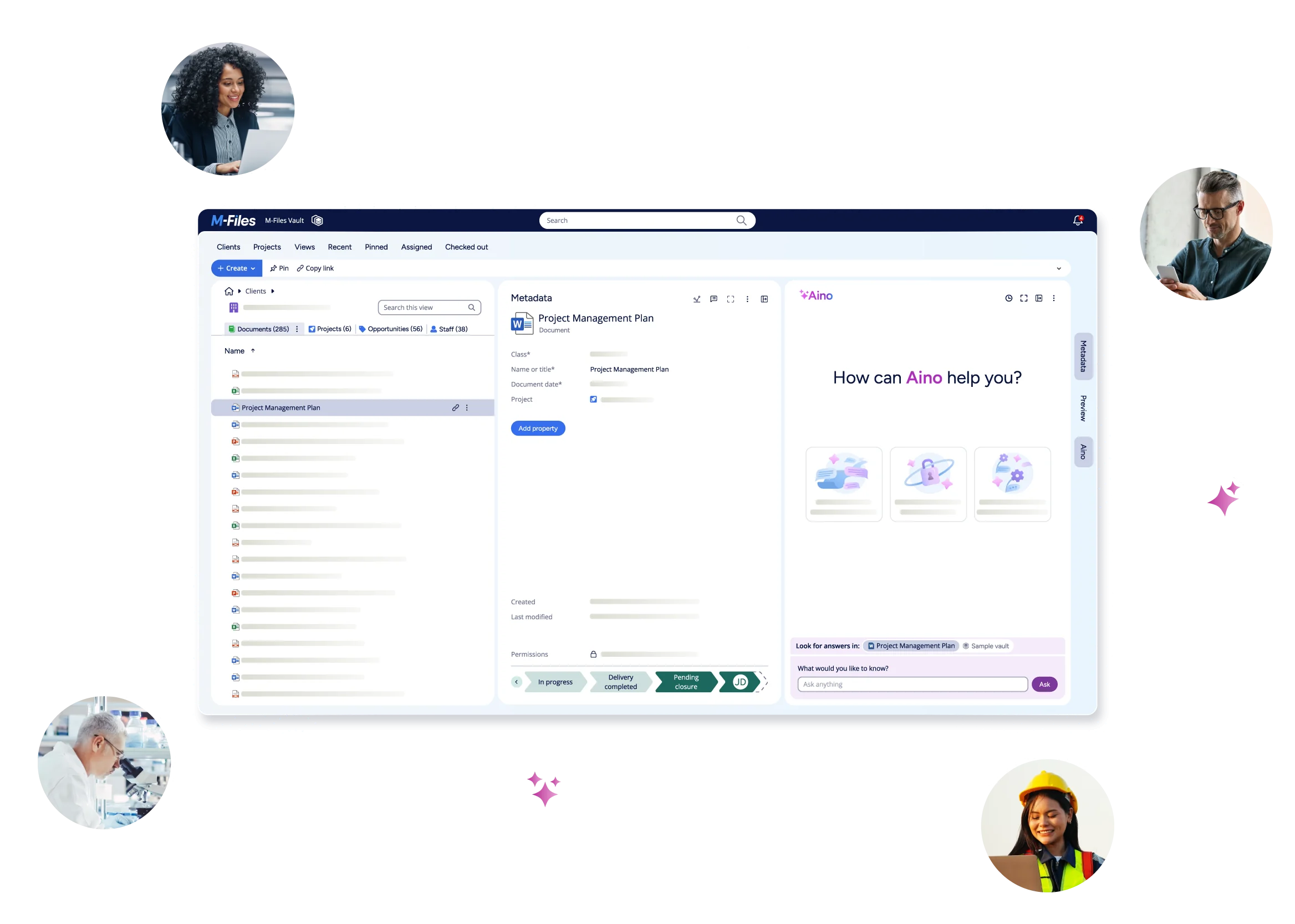
See M-Files in Action
Seeing is believing. Explore M-Files your way. Choose a live demo or a free 30-day trial to experience AI-powered content in context.