

The Document AI-Readiness Gap: Why AI Is Only as Good as the Information Behind It


For years, you've worked to digitize your documents. Today, as AI becomes part of everyday work, a more important question has emerged:
Are your documents actually ready for AI?
You might assume AI readiness starts with deploying a copilot, an assistant, or an autonomous agent. It starts much earlier, with the quality, governance, and business context of the information those systems rely on.
At M-Files, we call the shortfall the Document AI-Readiness Gap: the distance between the documents AI can reach and the trusted, contextual, governed information it needs to deliver reliable business outcomes. Closing that gap is one of the most important steps in scaling AI successfully in your organization.
Curious if your documents are ready for AI?
Take our AI readiness assessment
Your documents are the lifeblood of your business
Your documents aren't just files. They're where you conduct business, manage risk, demonstrate compliance, and capture institutional knowledge. Despite decades of digital transformation, they remain the foundation of how your work gets done, how your decisions are recorded, and how your business knowledge is preserved.
Think about how work happens in your organization, whatever your industry:
- Your contracts move through drafting, redlines, approvals, execution, and renewal.
- Your manufacturing teams manage engineering changes, specifications, drawings, and supplier documentation.
- Your HR team handles employee agreements, policies, onboarding materials, and compliance records.
- Your quality and compliance teams maintain SOPs, audit reports, corrective actions, and regulatory evidence.
- Your professional services teams create proposals, engagement letters, research, and client deliverables.
Most enterprise data is unstructured, a category that includes the documents, emails, and files your teams work with each day. At the Gartner® Data & Analytics Summit in London in May 2026, Gartner Distinguished VP Analyst Mark Beyer put the share at 70% to 90%,1 and Gartner called governing that data a key priority for making it AI-ready. Whatever form they take, your documents are where work gets done, compliance is upheld, and intellectual property is captured.
Chances are, your document volume and complexity have outgrown what people, folders, and manual processes can manage. And as you adopt AI, the stakes rise: AI inherits the state of the document environment it runs on.
AI doesn't fix a weak document foundation. It amplifies it.
The excitement around AI is justified. You’re probably already using it to speed up search, summarize information, automate tasks, and boost productivity. But AI can't solve your information management problems on its own. It reflects the quality of the information beneath it:
- If your content is outdated, AI surfaces outdated answers.
- If your documents are duplicated, AI inherits duplicate knowledge.
- If your business context is missing, AI has to make assumptions.
- If your governance is inconsistent, AI adds risk.
When you layer AI on top of a messy document environment, you get a false sense of progress. Information gets easier to retrieve, but not easier to trust. When AI runs on a digital filing cabinet, it amplifies the same problems:
- Hallucinations and inaccurate responses
- Ungoverned processes and decisions
- Runaway AI operating costs
- Compliance and governance risk
- Lower trust and slower adoption of AI across your organization
Gartner's research points the same way. It found that 63% of organizations either lack the right data management practices for AI or aren't sure they have them, and it predicts that through 2026, organizations will abandon 60% of AI projects that aren't supported by AI-ready data.2
The lesson is simple: AI doesn't fix a weak document foundation. AI exposes it.
The Document AI-Readiness Gap
Most organizations don't lack information. They lack connected information.
Your customer contract lives in one system. Your customer communications live in another. Project files sit somewhere else, approvals are tracked separately, and compliance requirements are stored elsewhere again. Your business-critical documents are likely spread across SharePoint, Teams, network drives, email, CRM, ERP, and line-of-business systems. At enterprise scale, they can connect to hundreds of stakeholders, hundreds of regulations, thousands of document-heavy processes, and millions of documents.
You can usually piece those relationships together. AI struggles when the connections are hidden.
That's the Document AI-Readiness Gap. It isn't defined by how many documents you have. It's defined by the difference between having information and having information that's AI-ready: connected to business context, governance controls, workflow history, permissions, and the relationships that explain how it fits into your organization.
Two ways to bring AI to your documents
You face a choice as AI adoption accelerates.
Option A: bolt AI onto your digital filing cabinet
The promise: faster retrieval.
The reality: the same weak foundation.
- Your documents sit in fragile folders as passive files.
- Connections between your customers, projects, and deliverables are incomplete, assumed, or missing.
- AI search runs on incomplete, assumed context.
- Static permission models can't keep up as your business changes.
- Problems amplify at scale, so every document you add increases both risk and cost.
Retrieval isn't understanding.
Option B: build AI on a contextual foundation
The promise: trusted AI that understands your business.
The reality: outcomes that scale.
- Relationships between your customers, projects, contracts, and deliverables are explicit and connected.
- Context is built for both your people and your AI agents, so AI understands meaning instead of matching keywords.
- Permissions are granular and aware of context.
- AI reasons over relationships, workflow, and provenance, not just file contents.
- Every document you add brings value instead of risk.

Why your AI needs context, not just content
Traditional repositories answer one question: where's the file? Your AI needs answers to very different questions:
- What does this information mean?
- Which customer, project, asset, or process does it relate to?
- Is it approved?
- What business rules apply?
- Who should have access?
- What should happen next?
Content tells AI what exists. Context tells AI what matters.
Take one of your contracts. The content includes clauses, obligations, dates, and signatures. The context includes your customer relationship, project history, approval chain, deliverables, compliance requirements, and communications. Together, they create understanding. The same is true of an engineering drawing and its product, a quality report and its corrective actions, or an employee record and the policies behind it.
This matters even more as you move from AI assistants to agents that automate work and support decisions. Agents need workflow awareness, governance, business rules, and trusted context.
That's the role M-Files plays. M-Files adds the context AI is missing by connecting your content to business meaning: the customers, projects, contracts, assets, and processes behind each document. Your AI understands what a document means, not just what it says. That connected, governed context gives you the foundation for trusted AI, whether your people use Copilot or your teams deploy agents.
How M-Files closes the gap for you
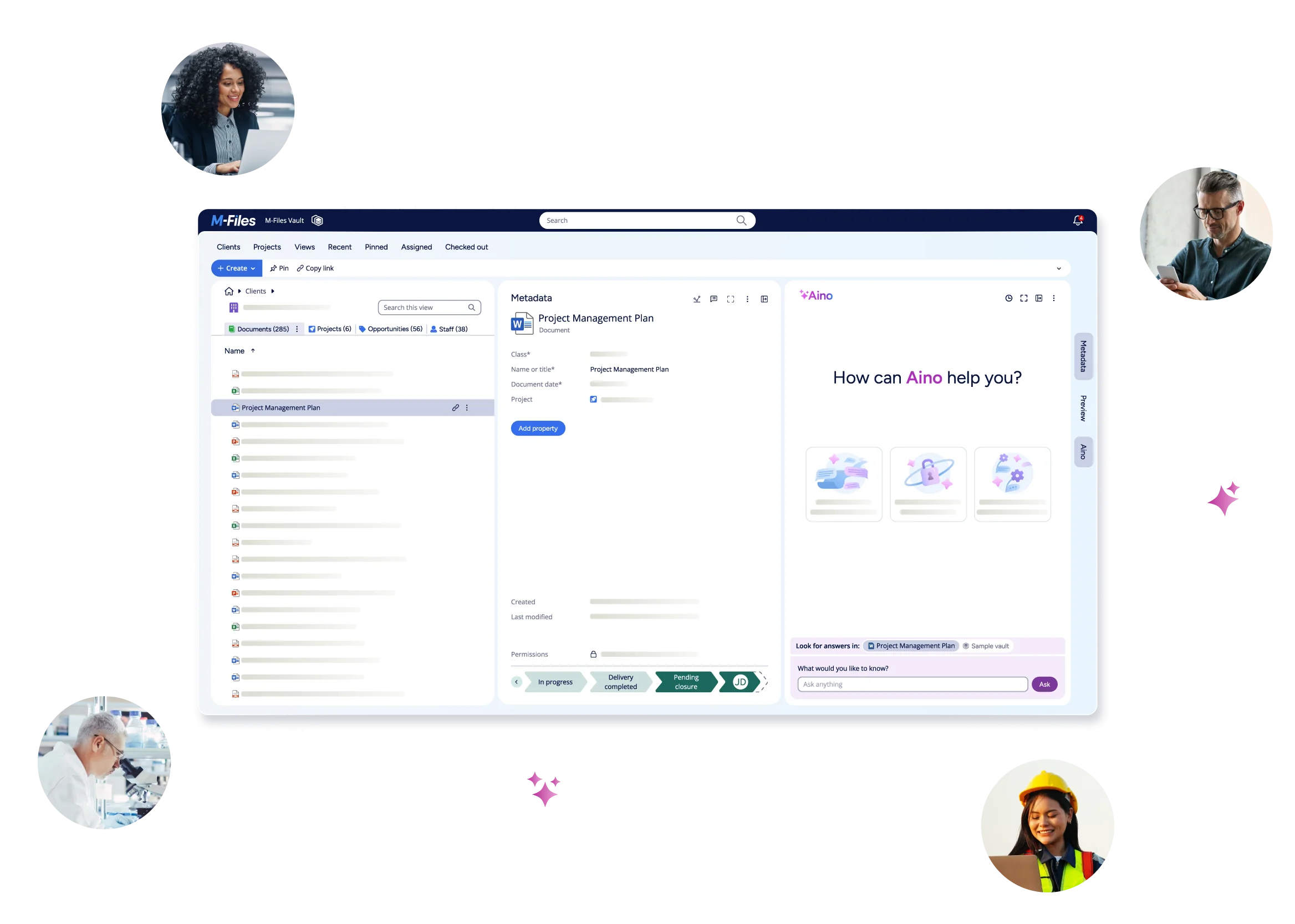
Document management is integral to who we are, and it's what makes AI readiness possible. M-Files helps you make your business-critical information AI-ready by applying metadata, governance, permissions, and business relationships that help Copilot and AI agents deliver more relevant and trustworthy results. Rather than organizing your documents by where they're stored, M-Files organizes them by what they represent and how they relate to your business: the customer, the project, the document type, the status.
Here's how that closes the Document AI-Readiness Gap:
- Metadata and business relationships replace folders. M-Files connects your content to the customers, projects, contracts, assets, and processes it supports.
- AI works on governed information. Aino, the trusted AI fabric of M-Files, delivers context-aware intelligence on your governed content, including metadata extraction and classification.
- Governance travels with your content. Workflows and permissions work alongside metadata and governance, so access rights and process steps stay attached to your information.
- It works where your people already work. M-Files connects your information across Microsoft 365 and your business systems, from SharePoint, Teams, and Outlook to Word, Excel, and PowerPoint, making information easier to find, manage, and use.
- Copilot and your AI agents get trusted information. M-Files helps Microsoft 365 Copilot access trusted, governed, and context-rich business information, enabling more relevant answers, insights, and actions. Your AI agents get the same governed, context-rich information, so they understand how your content relates to your customers, projects, contracts, assets, and business processes.
Microsoft creates, stores, secures, and delivers your information. M-Files adds business meaning by connecting your content to the people, customers, projects, contracts, assets, and processes that drive your business.
The result is that your documents stop being isolated files. A customer contract connects to the customer, project, approvals, communications, and obligations it supports. A quality document connects to audits, assets, suppliers, corrective actions, and regulatory requirements. A project file connects to deliverables, stakeholders, timelines, and business objectives.
Because M-Files also automates document-driven work, that context isn't just visible to AI. It puts your processes themselves on rails. You and your governed agents can act on critical work with confidence, because you can see what a document is, where it stands, and who's allowed to touch it.
Questions to ask before you scale AI
If you're preparing for enterprise AI, start by asking yourself:
- Do we know how our documents relate to our business processes?
Are those relationships explicit in our systems, or trapped in email and individual knowledge? - Is our governance consistent at scale?
Can we trust that permissions, approvals, and compliance controls are accurate across all of our documents? - Can we trace provenance?
When AI makes a recommendation, can we show where the information came from and whether it's approved? - Are our documents connected to business objects?
Do our contracts link to customers, our project files to deliverables, and our quality records to regulatory requirements? - How fragmented is our content?
How many systems hold information our AI will need?
If your answers point to disconnected, ungoverned, or fragmented information, you have a Document AI-Readiness Gap.
Successful AI starts with trusted business context
You won't succeed with AI because you have the most documents. You'll succeed because AI can understand the business meaning behind them.
When every one of your documents carries its context, governance, and relationships, each new one adds value instead of risk. That's the foundation your copilots, assistants, and autonomous agents need to operate with confidence.
Successful AI doesn't start with a model. It starts with trusted business context.
Not sure where your documents stand? The M-Files AI Readiness Assessment is a 10-question self-assessment that takes about five minutes and scores your organization across five dimensions, from metadata and classification to governed knowledge and process automation.
How ready is your content for AI?
Take the AI readiness assessment to identify gaps and prioritize your next steps.
See how M-Files connects your content to business context. Schedule a demo or talk to our team about your AI readiness goals.
Latest Articles
Browse Topics
Resources
See M-Files in Action